
AI Agents Explained: The Complete Guide for Beginners in 2026
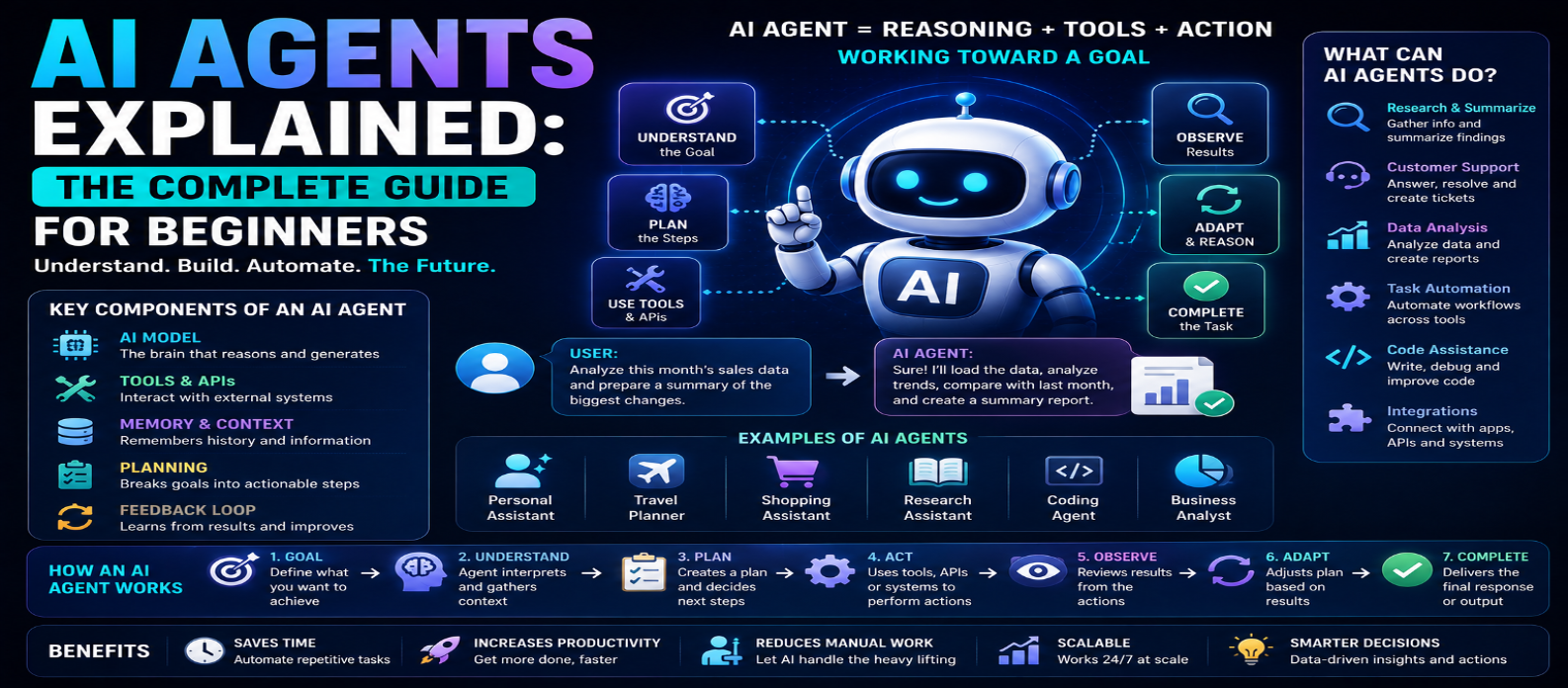
"Learn what AI agents are and how they work in this complete beginner's guide for 2026. Explore agentic AI, tools, memory, planning, APIs, RAG, single and multi-agent systems, automation, security, human approval, and how to build a basic AI agent."
AI Agents Explained: The Complete Guide for Beginners in 2026
Artificial intelligence is evolving from systems that simply answer questions into systems that can reason through tasks, use tools, interact with software, retrieve information, and perform multi-step workflows. This new generation of AI systems is commonly described as AI agents.
In 2026, AI agents are becoming increasingly important in software development, business automation, research, customer support, data analysis, and everyday productivity.
But what exactly is an AI agent? How is it different from a chatbot? And how does an AI agent actually work?
This beginner-friendly guide explains AI agents, their core components, how they work, common types, real-world applications, benefits, limitations, and how developers can start building agentic AI systems.
What Is an AI Agent?
An AI agent is an AI-powered system designed to work toward a goal by deciding what steps to take and, when permitted, using tools to complete those steps.
A traditional chatbot might answer:
"Here are five hotels you could consider."
An appropriately connected AI agent could potentially perform a broader workflow:
Understand Requirements → Search Available Information → Compare Options → Prepare Recommendations → Take an Approved Action
The key difference is that an agent can potentially do more than generate a response—it can participate in a multi-step process toward completing a task.
How Do AI Agents Work?
A simplified AI agent workflow looks like:
Goal → Understand → Plan → Use Tools → Observe Results → Adjust → Complete Task
Suppose you tell an AI agent:
"Analyze this month's sales data and prepare a summary of the biggest changes."
The agent might:
- Access the permitted sales data.
- Analyze the numbers.
- Identify significant changes.
- Compare them with previous periods.
- Generate a summary.
- Prepare a report.
More sophisticated agents may repeat certain steps until they reach an acceptable result or require human input.
AI Agents vs AI Chatbots
AI agents and chatbots can use similar underlying AI models, but their purposes can differ.
| Feature | AI Chatbot | AI Agent |
|---|---|---|
| Primary purpose | Conversation | Goal completion |
| Answers questions | Yes | Yes |
| Multi-step planning | Sometimes limited | Core capability |
| Uses tools | Can | Often |
| Performs actions | Sometimes | Can when authorized |
| Adapts workflow | Limited to advanced | Often designed to |
| Human approval | Useful | Important for sensitive actions |
The distinction isn't always strict. Many modern AI assistants combine conversational interfaces with agent-like capabilities.
The Core Components of an AI Agent
Most AI agent systems combine several important components.
1. AI Model
The AI model acts as an important reasoning and language-processing component.
It interprets instructions, analyzes information, generates responses, and can help decide what should happen next.
2. Goal or Instructions
The agent needs a clearly defined objective.
For example:
"Research the latest customer feedback and identify the five most common complaints."
Clear goals help reduce unnecessary actions and improve results.
3. Tools
Tools allow agents to interact with systems beyond the AI model.
Possible tools include:
- Web search
- Databases
- APIs
- Calculators
- Email systems
- Calendars
- File storage
- Business applications
- Code execution
Without tools, an AI model is primarily limited to processing the information provided to it and generating outputs.
4. Memory and Context
Agents may need information about previous steps.
Memory can include:
Conversation History → Previous Actions → Tool Results → User Preferences → Task State
Not every task requires long-term memory. Developers should store only information that is genuinely useful and appropriate.
5. Planning
Some agent systems break complex goals into smaller tasks.
For example:
Goal: Prepare Competitor Report
could become:
Find Competitors → Collect Information → Compare Features → Identify Differences → Generate Report
Planning makes complicated workflows easier to manage.
6. Feedback and Evaluation
An agent may evaluate the results of its previous action before deciding what to do next.
The cycle becomes:
Think → Act → Observe → Evaluate → Continue
In practical systems, developers should set limits so an agent cannot continue indefinitely.
What Can AI Agents Do?
AI agents can support many types of tasks.
Research
Agents can potentially:
- Search approved information sources
- Gather relevant information
- Compare findings
- Organize research
- Generate reports
Human verification remains important for factual research.
Customer Support
AI agents can help:
- Answer questions
- Search documentation
- Check permitted account information
- Create support tickets
- Route requests
- Escalate complex issues
Software Development
Coding agents can assist with:
- Generating code
- Debugging
- Running tests
- Reviewing errors
- Creating documentation
- Updating project files
Developers should review important changes before deployment.
Business Automation
Agents can connect multiple business systems.
For example:
New Lead → Analyze Inquiry → Classify Lead → Update CRM → Draft Follow-Up → Request Approval
This can reduce repetitive administrative work.
Data Analysis
An agent can potentially:
Load Data → Clean Data → Analyze Trends → Create Charts → Explain Findings → Generate Report
This makes AI particularly useful for repetitive analytical workflows.
What Are Single-Agent Systems?
A single-agent system uses one main AI agent to manage a task.
For many applications, this is the simplest approach.
Example:
User Request → Agent → Tools → Result
Single-agent architectures are generally easier to develop, test, monitor, and secure.
What Are Multi-Agent Systems?
A multi-agent system uses multiple specialized agents that cooperate on a larger task.
For example:
Research Agent → Analysis Agent → Writing Agent → Review Agent
Each agent may focus on a particular responsibility.
Multi-agent systems can be useful for some complex workflows, but they also introduce additional cost, latency, coordination, debugging, and reliability challenges.
Don't use multiple agents when one well-designed agent can complete the task effectively.
What Is Agentic AI?
Agentic AI broadly refers to AI systems designed with greater ability to pursue goals, make decisions within defined boundaries, use tools, and execute multi-step processes.
Traditional generative AI often follows:
Prompt → Response
Agentic AI may follow:
Goal → Plan → Action → Observation → Adjustment → Result
The amount of autonomy can vary significantly between systems.
AI Agents and APIs
APIs are essential for many AI agents because they allow the agent to interact with external software.
An agent might use APIs to:
Check Inventory → Retrieve Customer Data → Search Database → Create Ticket → Update Record
The AI should not receive unrestricted access.
Use minimum necessary permissions and validate every sensitive action.
AI Agents and RAG
Retrieval-Augmented Generation (RAG) allows an agent to access relevant knowledge before responding or acting.
A workflow might look like:
Question → Retrieve Documents → Analyze Information → Decide Action → Generate Response
This can help agents work with company documentation, policies, manuals, product information, and internal knowledge.
How to Build a Basic AI Agent
A simplified development process is:
Step 1: Define the goal
Choose one specific task.
Step 2: Choose an AI model
Select a model appropriate for the task.
Step 3: Define instructions
Specify what the agent can and cannot do.
Step 4: Add tools
Connect only the APIs or systems required.
Step 5: Manage context
Store relevant task state and tool results.
Step 6: Create the agent loop
Allow the agent to decide whether it needs another tool call or can return the final result.
Step 7: Add limits
Restrict tool usage, iterations, costs, and permissions.
Step 8: Test thoroughly
Test expected tasks, unusual inputs, failures, and malicious requests.
AI Agent Security
Giving AI the ability to perform actions creates additional risks.
Important safeguards include:
- Authentication
- Authorization
- Tool permissions
- Input validation
- Rate limits
- Spending limits
- Action logging
- Human approval
- Secure API credentials
- Maximum execution steps
A useful principle is:
Give the agent the minimum authority necessary to complete its job.
Human-in-the-Loop AI Agents
Not every action should happen automatically.
A safer workflow for sensitive actions is:
Agent Plans Action → Human Reviews → Human Approves → System Executes
Human approval is particularly valuable for actions involving:
- Financial transactions
- Deleting information
- Sending important communications
- Changing permissions
- Purchases
- Publishing content
- Critical business systems
The goal is controlled automation, not unlimited autonomy.
Benefits of AI Agents
When implemented properly, AI agents can provide:
Automation → Faster Workflows → Reduced Repetition → Tool Integration → Scalability → Personalized Assistance
They can help users move from manually operating several applications toward describing a goal and supervising the workflow.
Limitations of AI Agents
AI agents are not automatically reliable.
Potential problems include:
- Incorrect decisions
- Hallucinations
- Unnecessary tool calls
- Higher costs
- Security risks
- Privacy concerns
- Long execution times
- Unexpected behavior
- Complex debugging
Agents should therefore be monitored and evaluated continuously.
The Future of AI Agents
AI agents are likely to become increasingly integrated into websites, business applications, development environments, productivity software, and operating systems.
The evolution can be summarized as:
Chatbot → AI Assistant → AI Agent → Connected Agentic Workflows
But increased capability will make security, permissions, reliability, transparency, and human oversight even more important.
The most useful agents won't necessarily be those with maximum autonomy. They will be systems that reliably perform valuable tasks within clearly defined boundaries.
Conclusion
AI agents represent an important evolution in artificial intelligence.
Instead of simply responding to prompts, an AI agent can potentially:
Understand a Goal → Plan → Use Tools → Observe Results → Adjust → Complete the Task
The core technologies behind modern agents include AI models, APIs, tools, context, memory, planning, RAG, automation, and evaluation loops.
For beginners, the best approach is to start small. Build an agent for one clearly defined task, give it only the tools it needs, restrict its permissions, add human approval for sensitive actions, and test it carefully.
Understanding AI agents today provides a strong foundation for understanding how the next generation of AI-powered software and automation is being built.
Get a Free Access To 200+ Free Tools:
|
Home Page |
|
|
Calculator Tools |
|
|
Text & Converter Tools |
|
|
PDF & Image Tools |
|
|
Games & Developer Tools |
|
|
Resume Builder |