
AI-Powered Web Development: The Complete Guide for 2026
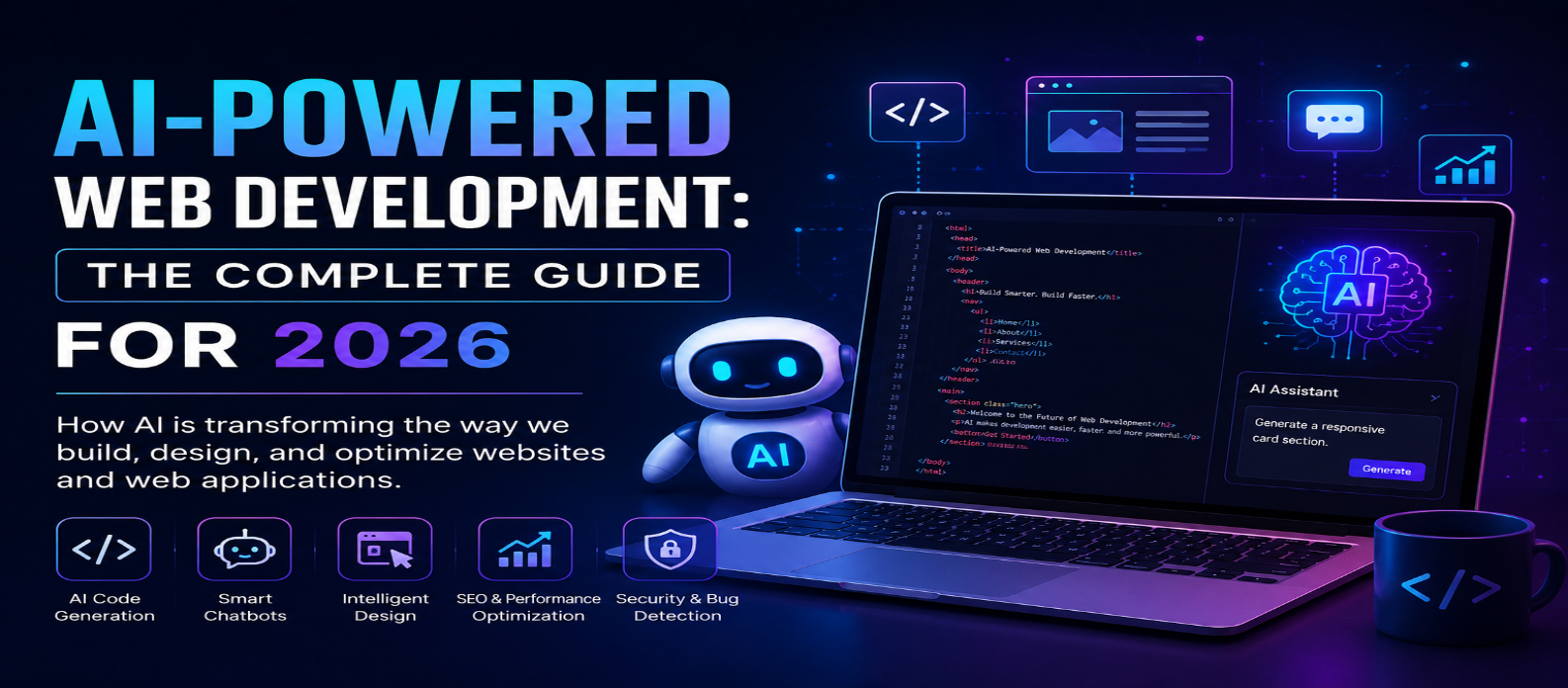
"Discover how AI is transforming web development in 2026. Learn how AI-powered tools can accelerate coding, design, testing, debugging, SEO, personalization, chatbots, and website optimization in this complete guide."
AI-Powered Web Development: The Complete Guide for 2026
AI-powered web development is changing how websites and web applications are designed, developed, tested, optimized, and maintained. In 2026, artificial intelligence is no longer limited to generating code. Developers can use AI to analyze requirements, create user interfaces, write and debug code, improve website performance, generate content, detect security issues, and build intelligent features.
This complete guide explains AI-powered web development, its benefits, common applications, essential technologies, and how businesses and developers can use AI to build better websites.
What Is AI-Powered Web Development?
AI-powered web development is the use of artificial intelligence and machine learning technologies throughout the website development process.
Traditional web development usually requires developers to manually handle tasks such as writing code, testing features, analyzing errors, creating content, and optimizing performance. AI can assist with many of these tasks and automate repetitive work.
AI can be integrated into both the development process and the final website.
For example, developers can use AI to generate JavaScript code, while a business can add an AI chatbot to its website to answer customer questions.
How AI Is Changing Web Development in 2026
AI is becoming an important part of modern development workflows. Some of the biggest changes include:
- Faster code generation
- Automated debugging
- AI-assisted UI design
- Automated testing
- Personalized website experiences
- AI chatbots and virtual assistants
- Intelligent search
- Automated content generation
- Website performance analysis
- Improved accessibility
- AI-assisted cybersecurity
Instead of replacing web developers completely, AI is increasingly being used as a development assistant that helps developers work faster and focus on more complex problems.
How AI Is Used in Web Development
1. AI-Assisted Coding
AI coding tools can generate code from natural-language instructions. Developers can describe what they want to build and use AI to create an initial implementation.
For example:
"Create a responsive navigation bar with a mobile hamburger menu."
AI can generate the required HTML, CSS, and JavaScript, which the developer can then review and modify.
2. AI Website Design
AI can help create website layouts, color combinations, typography suggestions, landing pages, and user-interface concepts.
This can significantly reduce the time required to move from an initial idea to a working prototype.
3. Automated Debugging
Finding bugs can consume a significant amount of development time. AI tools can analyze code, identify potential problems, explain errors, and suggest fixes.
However, developers should always verify AI-generated solutions before using them in production.
4. AI-Powered Testing
AI can assist with automated software testing by generating test cases, identifying unusual behavior, and analyzing test results.
This can help development teams identify problems earlier in the development lifecycle.
5. AI Chatbots
AI chatbots are one of the most visible applications of AI on websites.
Businesses can use AI assistants to:
- Answer frequently asked questions
- Provide product information
- Help customers navigate a website
- Generate support responses
- Collect basic customer information
6. Personalized User Experiences
AI can analyze user behavior and help websites provide more relevant recommendations.
For example, an e-commerce website can recommend products based on browsing behavior, previous purchases, or search activity.
7. Intelligent Website Search
Traditional website search generally matches keywords. AI-powered search can understand the meaning and context behind a user's query.
This can make it easier for visitors to find relevant products, articles, documents, or services.
Benefits of AI-Powered Web Development
AI can provide several advantages to developers and businesses.
Faster Development
AI can automate repetitive coding and development tasks, allowing developers to create prototypes and applications more quickly.
Lower Development Costs
Automating repetitive work can reduce the amount of time developers spend on routine tasks.
Better Productivity
Developers can use AI for brainstorming, code generation, documentation, debugging, testing, and research.
Improved User Experience
AI can power personalized recommendations, intelligent search, chatbots, voice interfaces, and other interactive features.
Faster Problem Solving
AI can analyze errors and suggest possible solutions, helping developers investigate problems more efficiently.
Popular AI Technologies for Web Development
A modern AI-powered web application may combine several technologies, including:
- Large language models (LLMs)
- Machine learning APIs
- AI chatbot APIs
- Natural language processing
- Computer vision
- Speech recognition
- Recommendation systems
- Vector databases
- Retrieval-Augmented Generation (RAG)
- AI agents
Developers can integrate these technologies through APIs and software development frameworks rather than building every AI model from scratch.
AI Web Development Workflow
A typical AI-assisted development workflow can look like this:
Idea → AI-assisted planning → UI design → Code generation → Testing → Debugging → Performance optimization → Security review → Deployment → Monitoring
AI can participate at several stages, but human review remains essential.
Is AI Replacing Web Developers?
AI is changing the role of web developers, but it does not eliminate the need for development expertise.
AI-generated code can contain:
- Security vulnerabilities
- Incorrect logic
- Outdated approaches
- Performance problems
- Compatibility issues
Developers still need to understand programming, architecture, databases, security, accessibility, testing, and deployment.
The most valuable skill in AI-assisted development is therefore not simply knowing how to generate code, but knowing how to evaluate, improve, and safely implement that code.
How to Start With AI-Powered Web Development
Beginners can start with a simple project instead of trying to build a complex AI application immediately.
A practical learning path is:
- Learn basic HTML, CSS, and JavaScript.
- Understand how APIs work.
- Learn a modern frontend framework.
- Learn basic backend development.
- Experiment with AI APIs.
- Build a simple AI chatbot or search feature.
- Learn database and authentication concepts.
- Study AI security and privacy.
- Test and optimize your application.
- Deploy your project and monitor its performance.
The Future of AI-Powered Web Development
AI-powered development is likely to become an increasingly normal part of the web development workflow. Developers will continue using AI for coding, testing, design, documentation, optimization, and application features.
At the same time, websites are becoming more intelligent through AI search, conversational interfaces, personalized content, recommendation systems, and AI agents.
The future of web development is therefore not simply AI replacing developers. It is more accurately described as developers working with AI to build more capable websites and applications faster.
Conclusion
AI-powered web development is one of the most important trends shaping the modern web in 2026. From AI-assisted coding and automated testing to intelligent search, chatbots, personalization, and AI agents, artificial intelligence can improve almost every stage of creating a website.
For developers, the best approach is to treat AI as a powerful assistant rather than a replacement for technical knowledge. Learning how to combine web development fundamentals with AI tools and APIs can help developers build faster, smarter, and more useful digital experiences.
As AI technology continues to evolve, understanding AI-powered web development today can provide a strong foundation for building the websites and applications of tomorrow.
Get a Free Access To 200+ Free Tools:
|
Home Page |
|
|
Calculator Tools |
|
|
Text & Converter Tools |
|
|
PDF & Image Tools |
|
|
Games & Developer Tools |
|
|
Resume Builder |