
AI Search Engines Explained: How Search Is Changing in 2026
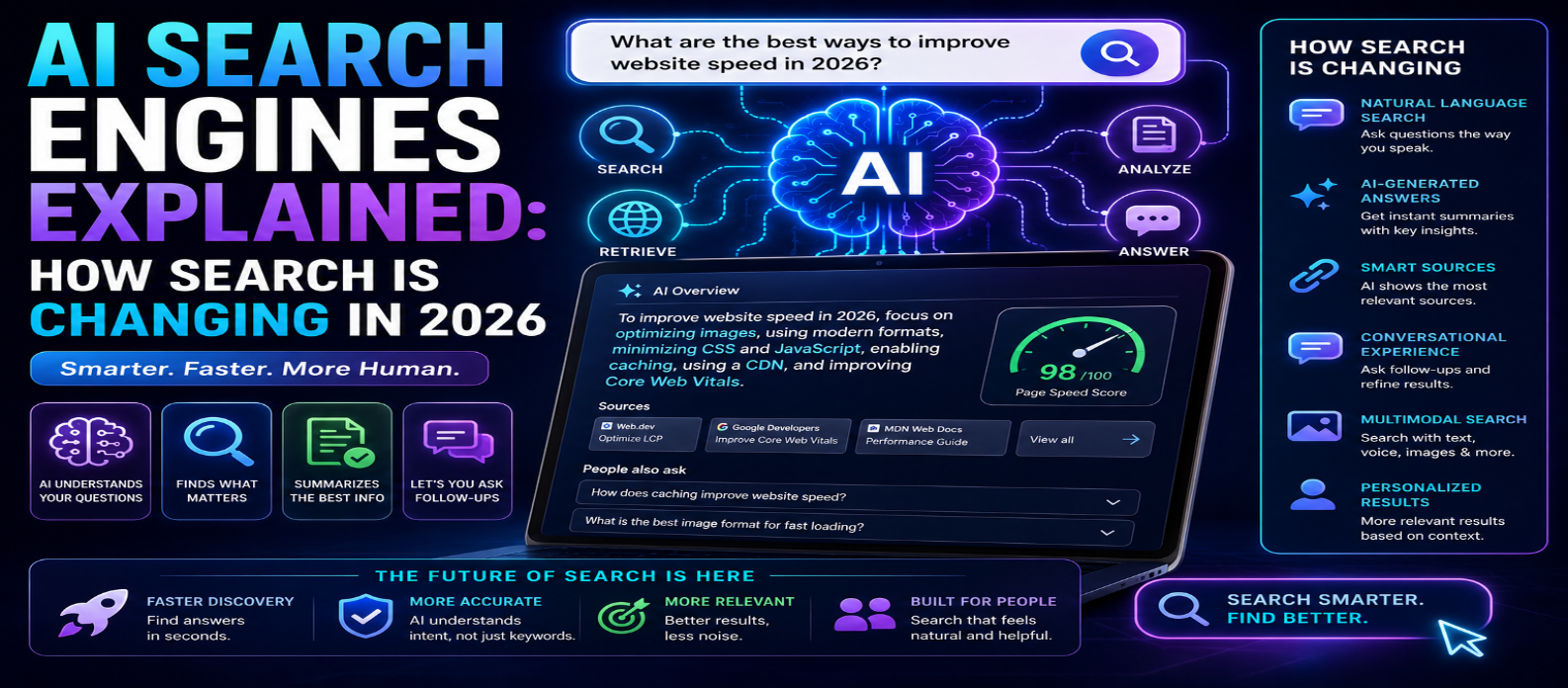
"Discover how AI search engines are changing search in 2026. Learn how AI search works, how it differs from traditional search, and how conversational search, RAG, generative answers, AEO, GEO, multimodal search, and evolving SEO are shaping the future of online discovery."
AI Search Engines Explained: How Search Is Changing in 2026
Search engines are undergoing one of their biggest transformations since the early days of the web. Traditional search has primarily helped users discover information by returning ranked pages. In 2026, AI search engines and AI-powered search experiences are increasingly able to understand natural-language questions, retrieve information from multiple sources, summarize findings, and support conversational follow-up questions.
Instead of searching with several short keyword queries and opening many pages, users can increasingly ask detailed questions such as:
"What are the best ways to improve the loading speed of a WordPress website without changing the hosting provider?"
An AI-powered search system can interpret the question, retrieve relevant information, organize the findings, and present a useful response.
This shift is changing how people search, how websites receive traffic, and how businesses should approach SEO and content creation.
What Is an AI Search Engine?
An AI search engine uses artificial intelligence to help understand search queries, retrieve relevant information, and present results in a more useful way.
Traditional search can be simplified as:
Keyword Query → Retrieve Pages → Rank Results → Display Links
AI-powered search can add additional steps:
Natural-Language Question → Understand Intent → Retrieve Information → Analyze → Generate Answer → Cite Sources → Allow Follow-Ups
This doesn't necessarily eliminate traditional search results. Many modern search experiences combine AI-generated answers with links, images, videos, products, maps, and other search features.
How Do AI Search Engines Work?
Different AI search systems use different architectures, but a simplified process can look like this:
1. User Asks a Question
The user enters a natural-language query.
For example:
"Which web development technologies should beginners learn in 2026?"
The system analyzes more than individual keywords. It attempts to understand the meaning and intent behind the question.
2. Information Is Retrieved
The search system finds potentially relevant information from its available search index, databases, connected sources, or other retrieval systems.
3. AI Analyzes the Information
An AI model can evaluate retrieved information and determine which parts are most relevant to the user's question.
4. An Answer Is Generated
Generative AI may organize the retrieved information into a direct, readable answer.
5. Sources Are Presented
Well-designed AI search experiences can provide links or citations so users can inspect the original information and explore the topic further.
6. Users Ask Follow-Up Questions
Instead of starting another search from scratch, users can continue conversationally.
For example:
User: "Which technologies should I learn?"
AI Search: Provides recommendations.
User: "Which three should I learn first if I only have six months?"
The system can use conversational context to understand the follow-up.
Traditional Search vs AI Search
| Feature | Traditional Search | AI Search |
|---|---|---|
| Typical input | Keywords | Natural-language questions |
| Main output | Ranked results | Answers + sources + results |
| Query understanding | Strong search intent systems | Search intent + generative AI |
| Follow-up questions | Usually new search | Conversational |
| Information synthesis | Mostly user | AI can assist |
| Exploration | Open multiple pages | Summary followed by deeper exploration |
| Multimodal input | Available in some systems | Increasingly integrated |
| User experience | Search and browse | Ask, answer, refine and explore |
The future is likely to combine both approaches rather than completely replace one with the other.
Why Is AI Search Growing?
Traditional search works extremely well when users know what they want.
For example:
"Facebook login"
doesn't require a long AI-generated explanation.
But complex questions can require users to open several pages, compare information, and construct an answer themselves.
AI search can reduce this work.
This makes it particularly useful for:
- Research
- Comparisons
- Complex questions
- Learning
- Recommendations
- Troubleshooting
- Planning
- Topic exploration
AI can function as an additional layer between finding information and understanding it.
Conversational Search Is Becoming More Important
People can increasingly search the way they naturally speak.
Instead of:
"best javascript framework beginners 2026"
a user might ask:
"I'm learning JavaScript and want to build full-stack applications. Which framework should I learn first in 2026 and why?"
This creates opportunities for content that answers specific questions and real-world problems rather than focusing entirely on short keyword phrases.
What Is Retrieval-Augmented Generation in AI Search?
One important concept behind many AI-powered information systems is Retrieval-Augmented Generation (RAG).
A simplified RAG workflow is:
Question → Retrieve Relevant Sources → Provide Information to AI → Generate Answer
Retrieval helps ground the AI response in relevant external information rather than relying entirely on what the model already knows.
For search applications, retrieval is especially important because web information changes constantly.
AI Search and Traditional Search Results
AI-generated answers don't necessarily mean the end of links.
Users may still need original websites when they want to:
- Read detailed research
- Verify claims
- Purchase something
- Use an online tool
- Download resources
- Watch videos
- Explore expert opinions
- Complete transactions
The role of search may shift from simply finding pages toward helping users decide which information deserves deeper exploration.
How AI Search Changes SEO
Traditional SEO often focuses on ranking web pages for relevant searches.
In an AI-search environment, website owners may increasingly think about two related goals:
Ranking in Search Results + Being Discoverable as a Useful Information Source
This makes content quality and clarity even more important.
Your content should make it easy to understand:
- What the page is about
- Which question it answers
- Who it is for
- What information is unique
- Why the information should be trusted
From SEO to AI Search Optimization
Terms such as AEO (Answer Engine Optimization) and GEO (Generative Engine Optimization) are increasingly used when discussing visibility in AI-generated search experiences.
You don't need to abandon SEO and chase every new acronym.
A strong foundation remains:
Technical SEO + Helpful Content + Clear Structure + Authority + Original Value
Content that is useful to humans is also more likely to provide useful information for search and AI systems.
How to Optimize Content for AI Search
1. Answer Questions Clearly
Don't bury the main answer beneath an unnecessarily long introduction.
Provide direct explanations followed by deeper detail.
2. Use Descriptive Headings
Organize content using meaningful headings such as:
What Is AI Search?
How Does AI Search Work?
Traditional Search vs AI Search
Clear structure helps readers and information systems understand your page.
3. Create Comprehensive Content
Cover the important subtopics users are likely to ask about.
For example, an AI search article might naturally cover:
How It Works → Benefits → Limitations → SEO Impact → Optimization → Future Trends
4. Add Original Value
Generic information is increasingly easy to generate.
Differentiate your content with:
- Original examples
- First-hand experience
- Research
- Data
- Screenshots
- Experiments
- Tools
- Templates
- Unique analysis
Original value gives users a stronger reason to visit your website.
5. Build Topic Authority
Instead of publishing unrelated articles, create interconnected content around important topics.
For example:
Artificial Intelligence
↓
AI Tools → AI APIs → AI Chatbots → AI Agents → AI Search → AI Automation
This creates a useful knowledge structure for visitors while providing natural internal-linking opportunities.
6. Maintain Strong Technical SEO
AI search doesn't remove the need for a technically healthy website.
Focus on:
- Crawlability
- Indexability
- Mobile responsiveness
- Fast loading
- HTTPS
- Clean URLs
- Internal links
- XML sitemaps
- Canonical tags
- Appropriate structured data
Search systems need to access and understand your content before they can effectively surface it.
Will AI Search Reduce Website Traffic?
It may change traffic patterns.
If an AI-generated answer completely satisfies a simple query, some users may not click through to a website.
This makes zero-click behavior an important consideration.
However, users still visit websites when they need deeper information, original research, products, tools, services, expert analysis, or detailed tutorials.
The strategic response is to create content that provides more value than a short summary can replace.
AI Search and Multimodal Search
AI search is also becoming increasingly multimodal.
Search can involve:
Text + Images + Voice + Video
A user might upload an image and ask:
"What is this object and how do I use it?"
or speak a complicated question instead of typing it.
Website optimization therefore increasingly extends beyond text.
Images, videos, structured information, accessibility, and descriptive context can all contribute to discoverability.
Challenges of AI Search Engines
AI search still has important limitations.
Potential problems include:
- Incorrect summaries
- Misinterpreted information
- Outdated sources
- Hallucinations
- Source attribution issues
- Bias
- Reduced context
- Difficulty evaluating conflicting information
Users should still verify important information using reliable original sources.
AI can accelerate research, but it shouldn't automatically be treated as the final authority.
What Website Owners Should Do in 2026
Don't redesign your entire content strategy around AI search alone.
Instead, build content that works across multiple discovery channels.
A practical strategy is:
Research Real Questions → Create High-Quality Content → Structure It Clearly → Add Original Value → Optimize Technical SEO → Build Authority → Update Important Pages
Your goal should be to become a valuable destination and information source, regardless of whether the visitor discovers you through traditional search, AI search, social media, or another platform.
The Future of Search
Search is evolving through several stages:
Keywords → Semantic Search → Intent Understanding → AI Answers → Conversational Search → Multimodal Search → AI Assistants
The search box itself may increasingly behave like an intelligent assistant.
Instead of simply asking:
"Which web pages match these keywords?"
search systems can increasingly help answer:
"What is this person trying to accomplish, what information is relevant, and what should they explore next?"
Conclusion
AI search engines are changing how people discover and consume information in 2026.
Traditional search focuses heavily on retrieving and ranking relevant pages, while AI search can add natural-language understanding, information synthesis, generative answers, source citations, conversational follow-ups, and multimodal interactions.
For website owners, this doesn't mean SEO is finished.
It means search optimization is evolving.
The strongest strategy is:
Excellent Content + Original Value + Clear Answers + Strong Technical SEO + Authority + AI-Friendly Structure
Search may continue changing, but websites that consistently provide information people genuinely want will remain valuable.
Get a Free Access To 200+ Free Tools:
|
Home Page |
|
|
Calculator Tools |
|
|
Text & Converter Tools |
|
|
PDF & Image Tools |
|
|
Games & Developer Tools |
|
|
Resume Builder |