AI vs Traditional Software: What Is Changing in 2026?
"Discover the key differences between AI and traditional software in 2026. Learn how generative AI, natural-language interfaces, intelligent automation, AI agents, personalization, and AI-assisted development are changing the future of software."
AI vs Traditional Software: What Is Changing in 2026?
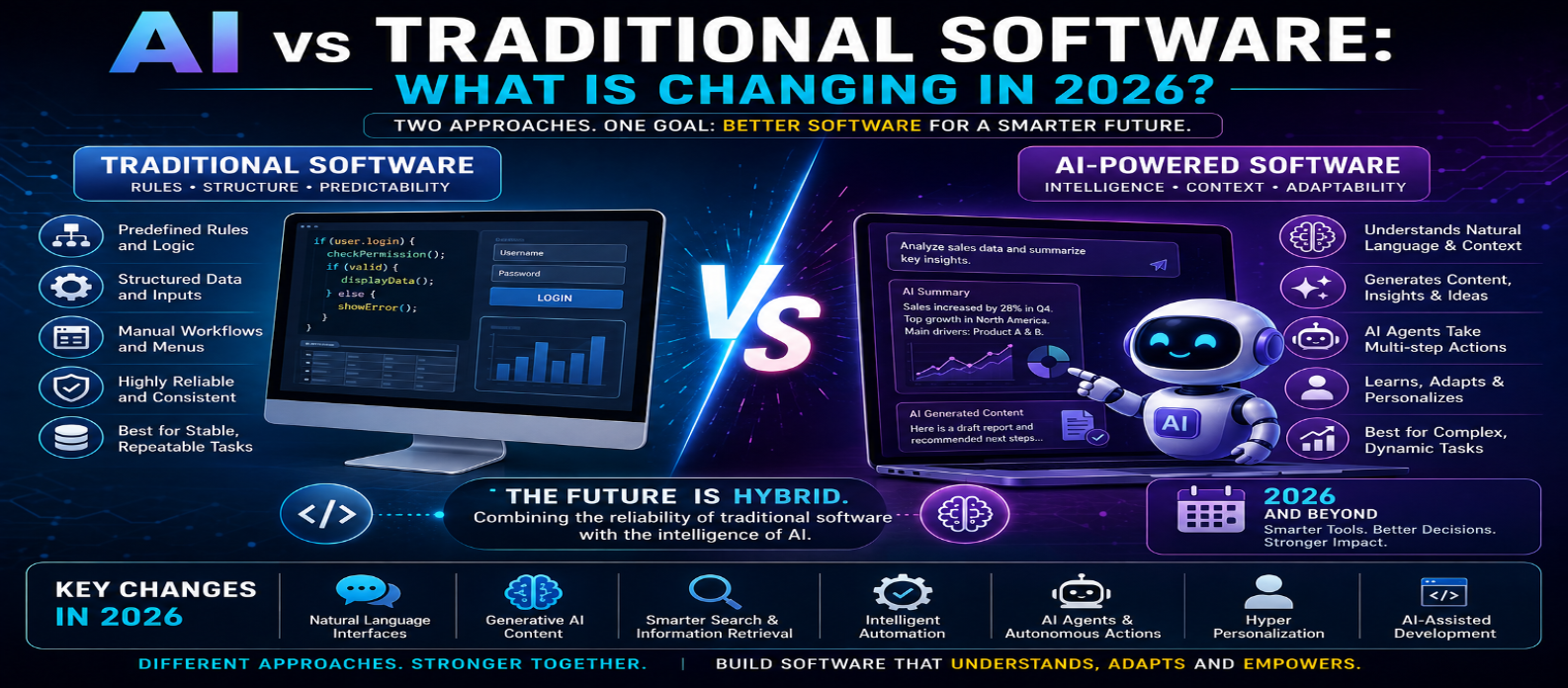
Software is going through one of its biggest transformations in decades. Traditional software has historically relied on predefined rules, menus, buttons, forms, and programmed workflows. In 2026, artificial intelligence is introducing a different approach: software that can understand natural language, generate content, analyze complex information, adapt to context, and increasingly perform multi-step tasks.
This doesn't mean traditional software is disappearing. Instead, the boundaries between traditional software and AI-powered software are becoming less distinct.
Businesses, developers, and everyday users are increasingly working with applications that combine reliable traditional programming with flexible AI capabilities.
This guide explains AI vs traditional software, their key differences, advantages, limitations, and what is changing in 2026.
What Is Traditional Software?
Traditional software is generally built around explicitly programmed logic.
A developer defines what should happen when users perform particular actions.
A simplified workflow might be:
User Action → Predefined Rule → Software Logic → Expected Result
Examples include:
- Calculators
- Accounting systems
- Word processors
- Database applications
- E-commerce platforms
- Booking systems
- Mobile apps
- Business management software
Traditional software excels when tasks require consistent, predictable, and repeatable behavior.
What Is AI-Powered Software?
AI-powered software incorporates artificial intelligence models to perform tasks that may be difficult to define using fixed rules alone.
AI can help software:
- Understand natural language
- Generate text
- Analyze images
- Summarize documents
- Write code
- Classify information
- Recognize patterns
- Generate images
- Make recommendations
- Assist with complex workflows
Instead of requiring users to navigate every feature manually, AI-powered applications may allow them to simply describe what they want.
AI vs Traditional Software: Key Difference
The fundamental difference is how tasks are handled.
Traditional Software
Input → Fixed Logic → Predictable Output
AI-Powered Software
Input + Context → AI Model → Generated or Inferred Output
For example, a traditional writing application may provide spelling and formatting tools.
An AI-enhanced writing application may additionally understand:
"Rewrite this paragraph for a beginner audience and make it more concise."
The AI interprets the instruction and generates a new version.
AI vs Traditional Software Comparison
| Feature | Traditional Software | AI-Powered Software |
|---|---|---|
| Core behavior | Predefined logic | Model-driven capabilities |
| Output | Usually predictable | Can vary |
| User interaction | Menus, forms, commands | Natural language + traditional UI |
| Content creation | Mostly user-created | Can generate content |
| Adaptability | Requires programmed changes | Can respond flexibly to context |
| Complex information | Rule-dependent | Can summarize and interpret |
| Reliability | Strong for deterministic tasks | Requires verification |
| Automation | Predefined workflows | Can support adaptive workflows |
| Human review | Depends on task | Often important for AI output |
The two approaches aren't competitors in every situation. Modern applications increasingly use both.
1. Natural Language Is Becoming a Software Interface
One of the biggest changes in 2026 is the rise of natural-language interfaces.
Previously, users needed to understand where a feature was located.
With AI, they may simply request:
"Analyze these sales numbers and summarize the biggest changes."
or:
"Create a professional presentation from this report."
Natural language can reduce the number of steps required to accomplish complex tasks.
Traditional interfaces won't disappear, but conversational interaction is becoming another important way to control software.
2. Software Is Moving From Tools to Assistants
Traditional software generally waits for the user to perform each action.
AI-powered applications can increasingly assist with the process itself.
For example:
Traditional: User manually reads a document.
AI-Assisted: Software summarizes the document and extracts action items.
Traditional: User creates a report.
AI-Assisted: Software analyzes data and prepares a first draft.
The user shifts from performing every step to directing, reviewing, and improving the work.
3. Generative AI Is Changing Content Creation
Traditional software helps people create content.
Generative AI can help produce the content itself.
AI can generate:
- Text
- Images
- Code
- Presentations
- Audio
- Video concepts
- Marketing materials
- Design variations
This can dramatically accelerate the first-draft stage.
However, generated content still needs human review for accuracy, originality, relevance, quality, and brand consistency.
4. AI Is Changing Search
Traditional search often depends heavily on keywords, filters, and exact matching.
AI-powered search can increasingly understand meaning and context.
Instead of searching:
"Q3 revenue report customer decline"
a user might ask:
"Why did customer revenue decline during the third quarter?"
The system can potentially retrieve relevant information and generate an explanation based on available data.
This makes software easier to use when large amounts of information are involved.
5. Automation Is Becoming More Intelligent
Traditional automation usually follows predefined rules:
If X Happens → Do Y
AI automation can introduce additional interpretation:
Event → AI Analyzes → Determines Category → Selects Approved Action → Result
For example, customer emails can be analyzed, categorized, summarized, and routed automatically.
This allows automation to handle information that isn't perfectly structured.
6. AI Agents Are Introducing Action-Oriented Software
AI agents represent another major shift.
Instead of only generating answers, an agent may be able to:
Understand Goal → Plan Steps → Use Tools → Perform Actions → Evaluate Result
An AI agent might potentially organize research, analyze files, update a system, and prepare a report within an approved workflow.
Greater autonomy also introduces greater responsibility around permissions, security, monitoring, and human approval.
7. Software Development Itself Is Changing
AI isn't only changing software products—it is changing how developers build them.
AI coding assistants can help with:
- Code generation
- Debugging
- Testing
- Documentation
- Refactoring
- Code explanation
- Prototyping
Developers can spend less time writing repetitive code and more time thinking about architecture, security, user experience, and business requirements.
8. Personalization Is Becoming More Dynamic
Traditional personalization often depends on predefined segments and rules.
AI can analyze more context to generate personalized experiences, recommendations, or content.
Potential applications include:
- Education
- E-commerce
- Customer support
- Productivity
- Marketing
- Entertainment
Personalization must still respect privacy, user consent, and applicable data-protection requirements.
9. Traditional Software Still Has Major Advantages
AI isn't automatically better.
Traditional software remains ideal for many tasks requiring:
- Exact calculations
- Deterministic behavior
- Strict business rules
- Reliable transactions
- Consistent outputs
- Low latency
- Clear auditability
You wouldn't want an accounting application to "creatively guess" the result of a financial calculation.
For critical operations, traditional programming remains essential.
10. AI Software Has Important Limitations
AI systems can sometimes:
- Produce incorrect answers
- Misinterpret instructions
- Generate inconsistent outputs
- Require significant computing resources
- Introduce privacy concerns
- Create security risks
- Require human verification
AI should therefore be used where its flexibility provides meaningful value—not simply added to every feature because it is popular.
The Hybrid Software Model Is Winning
The future isn't likely to be:
AI Software vs Traditional Software
It is increasingly:
Traditional Software + AI Models + Automation + Human Oversight
Traditional code can handle authentication, payments, permissions, databases, calculations, and business rules.
AI can handle language, generation, summarization, classification, interpretation, and assistance.
Together, they can create software that is both reliable and intelligent.
What Businesses Should Do in 2026
Businesses don't need to replace every existing application with an AI product.
Instead, identify processes where AI provides clear benefits.
Good candidates include:
Customer Support → Document Processing → Research → Content → Data Summaries → Internal Search → Repetitive Knowledge Work
Measure whether AI actually saves time, improves quality, or creates business value before expanding its use.
What Developers Should Learn
Developers should continue learning traditional software engineering fundamentals while adding AI-related skills.
Important areas include:
Programming + APIs + Databases + Security + Cloud + AI Models + Prompt Design + RAG + AI Agents
AI knowledge becomes much more valuable when combined with strong software-development fundamentals.
Conclusion
AI is not replacing traditional software in 2026. It is changing what software can do and how humans interact with it.
Traditional software remains essential for predictable logic, transactions, calculations, databases, and critical business operations.
AI adds new capabilities involving natural language, content generation, intelligent search, classification, automation, personalization, and AI agents.
The biggest transformation is therefore not:
Traditional Software → AI Replaces Everything
It is:
Traditional Software + AI Intelligence = The Next Generation of Software
The most successful applications will combine the reliability of traditional programming with the flexibility of artificial intelligence—giving users software that doesn't just provide tools, but increasingly helps them accomplish their goals.
Get a Free Access To 200+ Free Tools:
|
Home Page |
|
|
Calculator Tools |
|
|
Text & Converter Tools |
|
|
PDF & Image Tools |
|
|
Games & Developer Tools |
|
|
Resume Builder |