
The Complete Guide to Modern Web Development in 2026
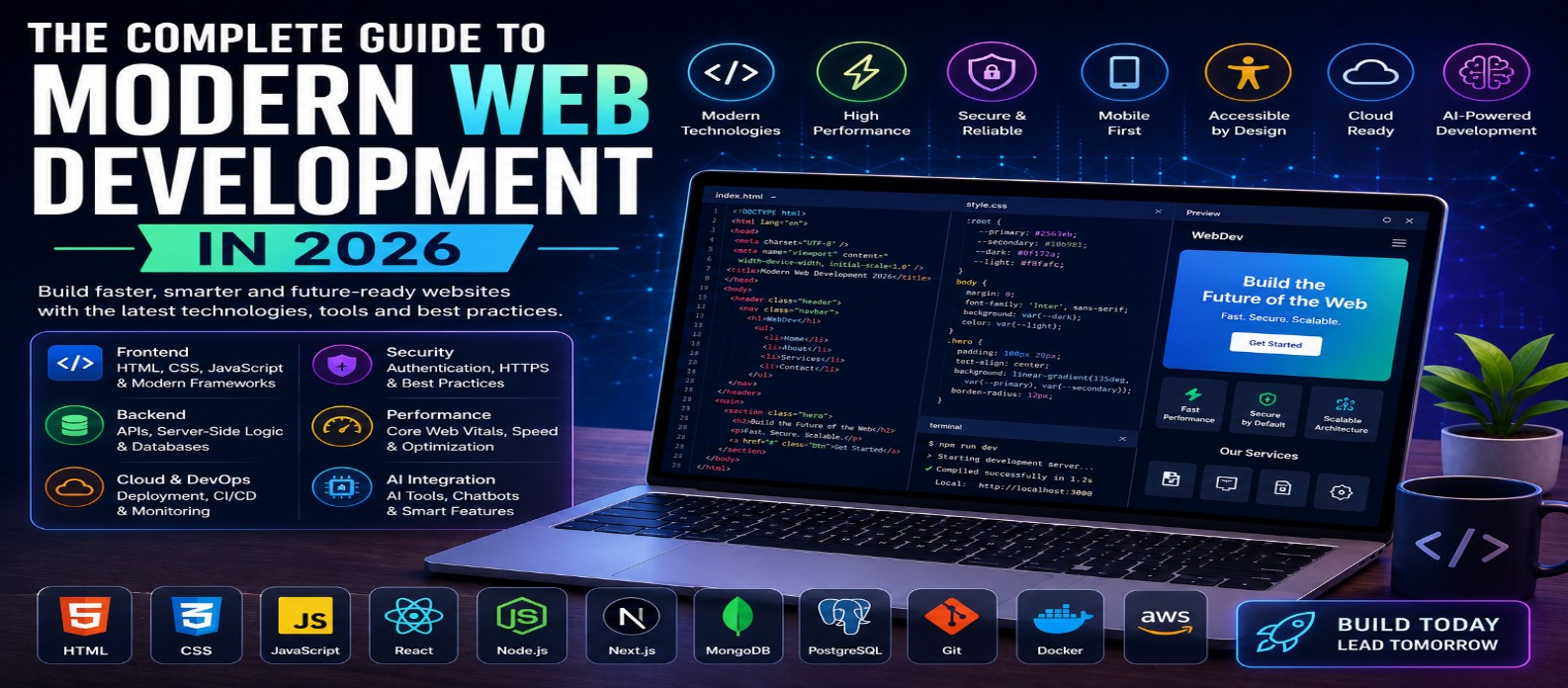
"Explore modern web development in 2026, including HTML, CSS, JavaScript, frameworks, APIs, AI, performance, accessibility, security, cloud deployment, and the latest web platform technologies."
The Complete Guide to Modern Web Development in 2026
Modern web development has changed dramatically. Websites are no longer built with only HTML, CSS, and JavaScript. Today's developers work with responsive interfaces, APIs, cloud services, modern browser capabilities, AI-powered tools, advanced security, performance optimization, and increasingly intelligent web applications.
In 2026, the focus is shifting toward building websites that are fast, accessible, secure, mobile-friendly, AI-ready, and compatible with modern browsers. This complete guide explains the essential technologies, practices, and trends shaping modern web development.
What Is Modern Web Development?
Modern web development is the process of creating websites and web applications using current web standards, development tools, frameworks, APIs, and best practices.
A modern website typically combines:
Frontend + Backend + APIs + Database + Security + Performance + Deployment
The frontend handles what visitors see and interact with, while the backend manages application logic, data, authentication, and services.
1. HTML: The Foundation of the Web
HTML remains the foundation of every website.
Modern HTML should focus on:
- Semantic elements
- Accessible content
- Forms
- Multimedia
- Structured page layouts
- Search-friendly markup
Good HTML improves maintainability, accessibility, and the ability of browsers and other systems to understand your content.
2. Modern CSS for Responsive Design
CSS has evolved far beyond basic colors and typography.
Modern developers can use features such as container style queries, advanced selectors, view transitions, modern sizing functions, and other newer CSS capabilities. Several of these have become part of Baseline 2026, indicating broad support across the core browser set.
Responsive design should ensure that websites work smoothly across:
Mobile → Tablet → Laptop → Desktop
3. JavaScript and Modern Web APIs
JavaScript remains a core technology for interactive websites and web applications.
Developers should understand:
- Variables and functions
- Arrays and objects
- DOM manipulation
- Events
- Modules
- Promises
- Async/await
- Fetch API
- JSON
- Browser APIs
The web platform itself continues to expand. In 2026, features such as WebTransport, Trusted Types, reporting APIs, improved JavaScript capabilities, and other platform features have entered the Baseline ecosystem.
4. Frontend Frameworks and Libraries
For larger applications, developers often use frameworks or libraries to manage complex interfaces.
Popular choices include:
- React
- Vue
- Angular
- Svelte
The important skill is not learning every framework. Instead, developers should understand components, state, routing, forms, API integration, rendering, and application architecture.
5. Backend Development and APIs
Modern web applications depend heavily on backend services.
Common backend technologies include:
- Node.js
- Python
- PHP
- Java
- .NET
Developers should understand REST APIs, authentication, databases, server-side logic, HTTP methods, JSON, error handling, and API security.
6. Databases and Data Management
Web applications commonly use either SQL or NoSQL databases.
SQL: PostgreSQL, MySQL, SQL Server
NoSQL: MongoDB and other document or key-value databases
Choosing the correct database depends on the application's data structure, queries, scalability, and business requirements.
7. AI-Powered Web Development
AI is becoming an important part of modern development.
Developers can use AI to assist with:
- Code generation
- Debugging
- Testing
- Documentation
- UI creation
- Research
- Automation
- Content generation
AI can also become part of the website itself through chatbots, intelligent search, recommendations, personalization, and other features. Web.dev now provides dedicated AI learning resources for web developers covering predictive AI, generative AI, and practical AI use cases.
The best approach is to use AI as an assistant while maintaining human review of architecture, security, accuracy, and quality.
8. Website Performance
Performance is essential to modern web development.
Focus on:
- Optimized images
- Efficient JavaScript
- CSS optimization
- Caching
- Compression
- Fast server responses
- Minimal unnecessary requests
- Core Web Vitals
Developers should also monitor real-world performance rather than relying only on local testing.
9. Accessibility
A modern website should be usable by as many people as possible.
Use:
- Semantic HTML
- Keyboard-friendly navigation
- Descriptive labels
- Appropriate alternative text
- Clear focus states
- Accessible forms
- Sufficient color contrast
Accessibility should be considered during design and development rather than added at the end.
10. Security
Security is a fundamental part of professional web development.
Developers should understand:
- HTTPS
- Authentication
- Authorization
- Password protection
- Input validation
- XSS
- CSRF
- SQL injection
- Secure cookies
- API security
- Content Security Policy
Security problems can affect user trust, data, and business operations, so they should be addressed throughout the development lifecycle.
11. Modern Development Tools
A professional workflow usually includes tools for:
Code editing → Version control → Testing → Performance audits → Deployment → Monitoring
Git and GitHub are widely used for version control and collaboration.
Modern developer tooling is also becoming more capable of checking browser compatibility. Lighthouse now includes a Baseline Features audit, which can show whether web platform features used by a page are widely available, newly available, or have limited availability.
12. Deployment and Cloud Technologies
Modern websites can be deployed using traditional hosting, cloud platforms, serverless infrastructure, or containerized environments.
Important concepts include:
- Domains and DNS
- HTTPS
- Hosting
- Environment variables
- CI/CD
- Containers
- Serverless functions
- Monitoring
- Backups
Understanding deployment makes developers more capable of managing applications from development through production.
What Is New in Web Development in 2026?
The modern web is increasingly focused on platform capabilities rather than unnecessary dependencies. Baseline 2026 includes numerous CSS, JavaScript, and Web API features that developers can evaluate for broader browser compatibility.
At the same time, AI is becoming integrated into both development workflows and web applications. Browser capabilities and developer tooling are also evolving rapidly, making it important to regularly check current browser support rather than relying on outdated assumptions.
Modern Web Development Best Practices
A high-quality modern website should aim to be:
Fast + Secure + Accessible + Responsive + SEO-Friendly + Maintainable + Mobile-Friendly
Avoid adopting technologies simply because they are new. Choose tools according to the project's actual requirements, browser support, performance needs, security considerations, and long-term maintainability.
Conclusion
Modern web development in 2026 combines established fundamentals with powerful new technologies. HTML, CSS, and JavaScript remain essential, while frameworks, APIs, cloud platforms, AI, modern browser capabilities, performance optimization, accessibility, and security expand what developers can build.
The most effective developers are not those who chase every new framework. They are the ones who understand the fundamentals, choose the right tools, follow modern web standards, and continuously adapt as the platform evolves.
For website owners and developers, the goal is simple: build web experiences that are fast, useful, secure, accessible, and ready for the future.