
Full-Stack Web Development in 2026: Everything You Need to Know
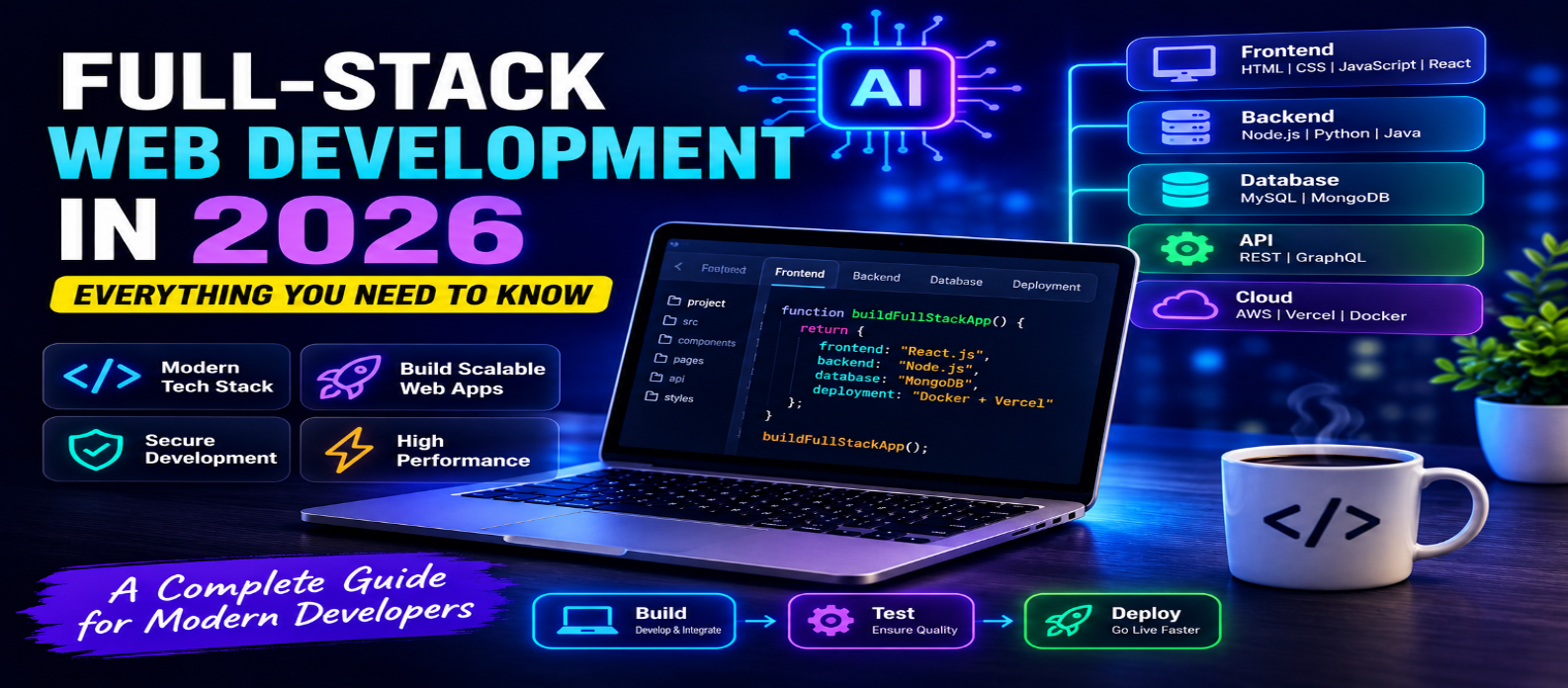
"Learn everything about full-stack web development in 2026, including frontend, backend, databases, APIs, cloud deployment, security, AI tools, and the skills developers need to build modern web applications."
Full-Stack Web Development in 2026: Everything You Need to Know
Full-stack web development continues to be one of the most valuable areas of software development in 2026. A full-stack developer can work across the frontend, backend, database, APIs, and deployment layers of a web application.
Modern development is also changing rapidly. Cloud platforms, AI-assisted coding, modern frameworks, automated testing, and stronger security practices are becoming essential parts of the development workflow.
Whether you are starting your career or upgrading your existing skills, understanding the modern full-stack ecosystem can help you build faster, more reliable, and scalable web applications.
What Is Full-Stack Web Development?
Full-stack web development involves building both the client-side and server-side components of a website or web application.
The frontend is what users see and interact with, while the backend handles business logic, authentication, APIs, databases, and server-side operations.
A full-stack developer understands how these layers communicate and work together to deliver a complete application.
1. Frontend Development
Frontend development focuses on creating the user interface and user experience.
Essential technologies include:
- HTML for page structure
- CSS for styling and responsive layouts
- JavaScript or TypeScript for application logic
- Modern frontend frameworks and libraries
- Accessibility and responsive design principles
In 2026, developers should focus not only on attractive interfaces but also on performance, accessibility, usability, and maintainable component-based architecture.
2. Backend Development
The backend powers the functionality behind the interface. It processes requests, manages business logic, authenticates users, communicates with databases, and provides APIs.
Popular backend technologies include JavaScript/TypeScript runtimes, Python, Java, PHP, Go, and other server-side ecosystems.
Rather than trying to learn every programming language, beginners should choose one backend stack and develop a strong understanding of APIs, authentication, databases, error handling, and application architecture.
3. Databases
Most modern applications need a reliable way to store and retrieve information.
Full-stack developers should understand both major database approaches:
Relational databases organize structured data using tables and relationships. SQL remains an essential skill for working with relational databases.
NoSQL databases can provide flexible data models and are useful for certain application architectures and workloads.
The right database depends on the application's requirements, scalability needs, data relationships, and development environment.
4. APIs and Application Communication
APIs allow different parts of an application to communicate with each other. A frontend may use an API to request user information, submit forms, process payments, or retrieve database records.
Developers should understand concepts such as HTTP methods, status codes, authentication, JSON, REST APIs, and modern API architectures.
Good API design improves maintainability and makes applications easier to integrate with other services.
5. Authentication and Security
Security is a fundamental part of full-stack development. Developers need to understand secure authentication, authorization, password handling, session management, input validation, and protection against common web vulnerabilities.
Always use HTTPS, keep dependencies updated, validate untrusted input, protect sensitive data, and follow established security practices.
Security should be considered during development rather than added after an application is finished.
6. Git and Collaborative Development
Version control is essential for professional development. Git allows developers to track changes, create branches, collaborate with teams, and safely experiment with new features.
Learn how to create commits, work with branches, resolve merge conflicts, review code, and use pull requests effectively.
These skills are valuable whether you work independently or as part of a development team.
7. Cloud and Deployment
Building an application is only part of the process. Full-stack developers also need to understand how applications are deployed and maintained.
Modern cloud platforms can provide hosting, databases, storage, serverless functions, containers, monitoring, and other infrastructure services.
Learn the fundamentals of environment variables, domains, HTTPS, deployment pipelines, logs, backups, and application monitoring.
8. Testing and Performance
Reliable applications need testing. Developers should understand unit testing, integration testing, end-to-end testing, and automated testing workflows.
Performance is equally important. Optimize images, reduce unnecessary JavaScript, improve database queries, use caching where appropriate, and monitor important user-facing performance metrics.
A fast application is generally easier and more enjoyable to use.
9. AI in Full-Stack Development
AI is becoming an important development assistant in 2026. Developers can use AI to generate boilerplate code, explain unfamiliar code, create tests, debug errors, write documentation, and explore implementation approaches.
However, AI-generated code still requires human review. Developers must understand the code they ship and verify its security, correctness, performance, and maintainability.
The goal is not to replace development knowledge but to use AI to become more productive.
10. The Modern Full-Stack Developer Skill Set
A strong full-stack developer should gradually build skills across:
- HTML, CSS, JavaScript, and TypeScript
- Frontend frameworks
- Backend development
- SQL and database fundamentals
- APIs and authentication
- Git and collaboration
- Testing and debugging
- Cloud deployment
- Security
- Performance optimization
- AI-assisted development
You do not need to master everything at once. Build a complete project and learn each technology as it becomes necessary.
How to Become a Full-Stack Developer in 2026
The best way to learn full-stack development is through practical projects. Start with a simple application, then gradually add authentication, database functionality, APIs, testing, and deployment.
Build projects that solve real problems rather than only following tutorials. Create a portfolio that demonstrates how you design, develop, secure, test, and deploy applications.
Most importantly, keep learning. The tools and frameworks will continue to change, but strong fundamentals in programming, web architecture, databases, security, and problem-solving remain valuable.
Final Thoughts
Full-stack web development in 2026 combines frontend development, backend engineering, databases, APIs, cloud technologies, security, testing, and AI-assisted workflows.
You do not need to learn every tool available. Choose a practical technology stack, understand the fundamentals, and build real applications from start to finish.
With consistent practice and a willingness to adapt, full-stack development can provide a strong foundation for building modern web applications and pursuing a career in web development.
Get a Free Access To 200+ Free Tools:
|
Home Page |
|
|
Calculator Tools |
|
|
Text & Converter Tools |
|
|
PDF & Image Tools |
|
|
Games & Developer Tools |
|
|
Resume Builder |