
The Future of Web Development: Technologies Developers Should Learn
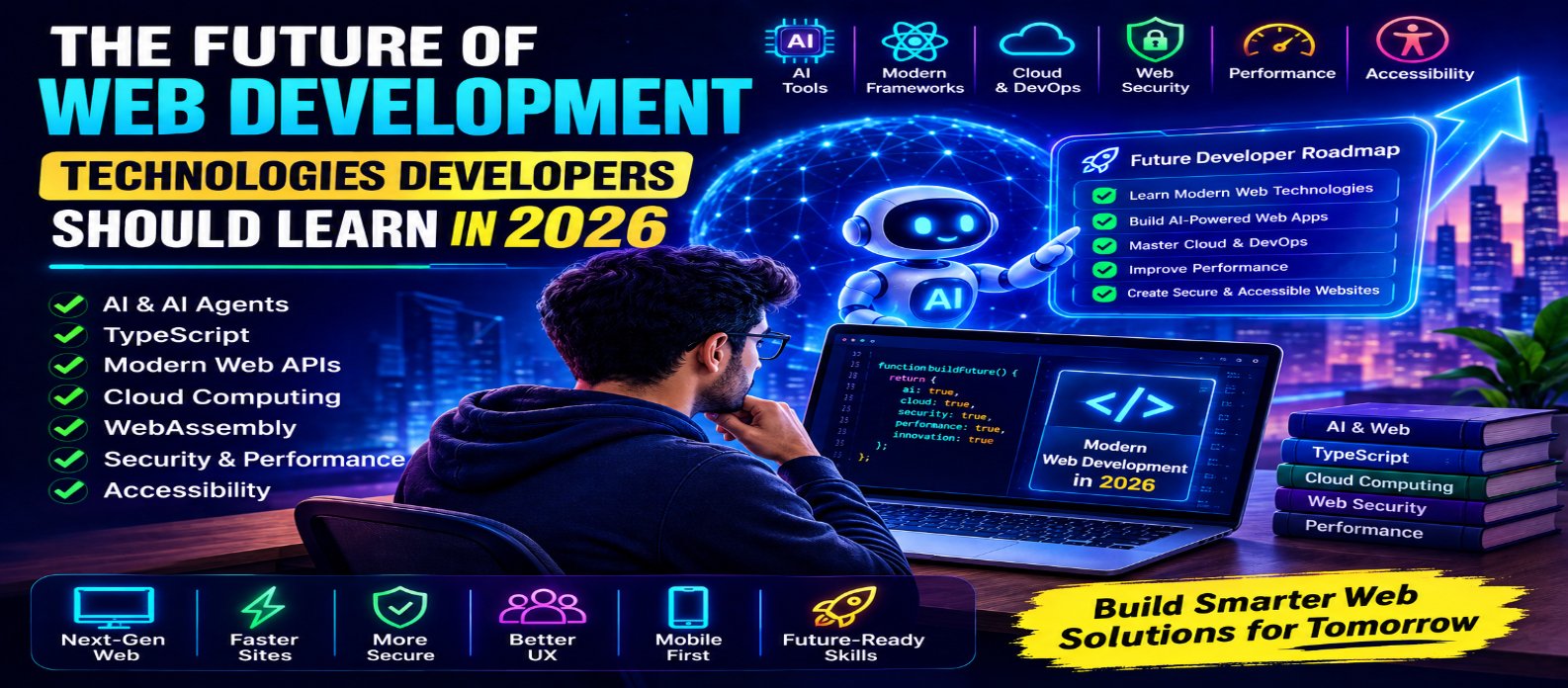
"Explore the future of web development and discover the technologies developers should learn in 2026, including AI, AI agents, TypeScript, modern Web APIs, cloud computing, WebAssembly, security, performance, and accessibility."
The Future of Web Development: Technologies Developers Should Learn
Web development is entering a new phase in 2026. HTML, CSS, JavaScript, APIs, and databases remain fundamental, but developers are increasingly working with artificial intelligence, AI agents, modern browser APIs, cloud platforms, automation, and advanced performance tools.
The goal is no longer simply to build a website that works. Modern developers need to create experiences that are fast, secure, accessible, responsive, intelligent, and adaptable.
This guide covers the most important technologies and skills developers should learn to stay relevant in the future of web development.
1. HTML, CSS and JavaScript Remain Essential
Despite the growth of AI and frameworks, the core web technologies are not disappearing.
Developers should have a strong understanding of:
- Semantic HTML
- Modern CSS
- Responsive design
- JavaScript
- DOM and browser APIs
- Asynchronous programming
- HTTP and networking
The fundamentals become even more important when AI tools generate code because developers need to understand and review what those tools produce.
2. AI-Assisted Development
AI is becoming a standard part of the developer workflow.
Developers can use AI to generate code, explain unfamiliar codebases, debug errors, write tests, create documentation, and automate repetitive tasks.
However, the role of the developer is changing from simply writing code toward specifying requirements, reviewing implementations, testing results, and making architectural decisions. Google has specifically described this shift toward AI-assisted software engineering and emphasized the need for human supervision of generated code.
Learning how to work effectively with AI coding tools will therefore be an increasingly valuable skill.
3. AI Agents and Agentic Development
One of the biggest developments in web development is the rise of AI agents.
Unlike a basic chatbot that responds to a question, an AI agent can plan and execute multiple steps to complete a task.
Developers should learn concepts such as:
- AI agents
- Tool calling
- Multi-agent systems
- Agent workflows
- Context management
- Retrieval-Augmented Generation
- Agent security
- Evaluation and monitoring
Google's 2026 developer announcements highlight the move from AI that merely assists developers toward agents capable of independently handling more complex workflows.
4. Web APIs and Modern Browser Capabilities
The browser itself continues to become more powerful.
Web Platform Baseline provides developers with information about which modern features are interoperable across the core browsers. Baseline 2026 includes features across HTML, CSS, JavaScript, WebAssembly, security, networking, and other Web APIs.
Developers should therefore learn how to use native browser capabilities instead of automatically relying on external libraries for every feature.
5. AI-Ready Websites
The future web may increasingly be accessed by AI agents as well as humans.
Google's proposed WebMCP is designed to let websites expose structured tools such as JavaScript functions and HTML forms so browser-based AI agents can interact with websites more reliably.
This creates a new concept for developers: websites should not only be designed for human interaction but may also need to provide structured interfaces that AI systems can understand and use.
6. TypeScript and Modern JavaScript Development
As applications become larger, strong typing and better tooling become increasingly valuable.
Developers working with modern JavaScript ecosystems should consider learning TypeScript, along with:
- Modules
- Async programming
- APIs
- Error handling
- Testing
- Build systems
- Modern application architecture
The goal is not just writing more code but making applications easier to maintain and scale.
7. Frontend Frameworks
Modern web applications commonly use frameworks or libraries to manage complex user interfaces.
Developers can explore technologies such as:
- React
- Vue
- Angular
- Svelte
Learning one framework deeply is generally more useful than learning several superficially. Focus on components, state management, routing, data fetching, rendering, accessibility, and performance.
8. Backend, APIs and Cloud Computing
Modern web applications depend heavily on backend infrastructure.
Developers should understand:
Servers → APIs → Databases → Authentication → Cloud → Deployment
Cloud platforms, serverless functions, containers, and managed databases can make it easier to build and scale applications without managing every part of the underlying infrastructure manually.
9. Web Performance
Fast websites will remain important as applications become more complex.
Developers should learn:
- Core Web Vitals
- Image optimization
- Caching
- CDN
- Efficient JavaScript
- Code splitting
- Network optimization
- Server performance
Performance should be tested throughout development rather than treated as a final step.
10. Web Security
As applications become more connected and intelligent, security becomes even more important.
Developers should understand:
- HTTPS
- Authentication
- Authorization
- Secure cookies
- XSS
- CSRF
- SQL injection
- API security
- Content Security Policy
- Secrets management
AI-powered applications also introduce additional concerns around data privacy, prompt injection, tool permissions, and unauthorized agent actions.
11. Accessibility and Inclusive Design
Accessibility should remain a core development skill.
Learn how to build interfaces that support:
- Keyboard navigation
- Screen readers
- Accessible forms
- Semantic HTML
- Appropriate focus states
- Clear labels
- Responsive layouts
Accessible design also generally leads to better usability across a wider range of devices and users.
12. WebAssembly and High-Performance Web Apps
WebAssembly allows code written in languages beyond JavaScript to run efficiently in browsers.
It can be useful for demanding applications involving areas such as:
- Gaming
- Image processing
- Video processing
- Data visualization
- Scientific applications
- Advanced developer tools
Developers don't need to use WebAssembly for every website, but understanding where it provides value can become an advantage for specialized applications.
13. Progressive Web Apps and Modern Web Experiences
Progressive Web App technologies allow websites to provide application-like functionality.
Depending on browser capabilities and project requirements, developers can explore:
- Service workers
- Offline functionality
- Web app manifests
- Push notifications
- Installable experiences
- Local storage
These technologies can make web applications more capable without requiring a traditional native application for every use case.
14. Learn Modern Development Tooling
The development environment itself is evolving rapidly.
Developers should become comfortable with:
- Git and GitHub
- Package managers
- Build tools
- Automated testing
- CI/CD
- Browser DevTools
- Performance auditing
- AI coding assistants
Tools such as Lighthouse are also incorporating Baseline-related analysis to help developers understand the browser support of modern features used on a page.
15. Continuous Learning Will Be the Most Important Skill
Perhaps the most important technology for the future of web development is the ability to keep learning.
New frameworks, APIs, AI models, browser capabilities, and development tools will continue to appear.
Instead of trying to memorize every new technology, developers should learn how to evaluate new tools based on:
Compatibility → Security → Performance → Maintainability → Developer experience → Project requirements
This approach makes it easier to adapt when technologies change.
Future Web Developer Roadmap
A practical long-term learning path is:
HTML → CSS → JavaScript → Git → TypeScript → Frontend Framework → Backend → Databases → APIs → Cloud → Security → Testing → Performance → AI → AI Agents → Modern Web APIs
You don't need to master everything simultaneously. Build projects and gradually add new technologies as your skills improve.
Conclusion
The future of web development is not about replacing traditional development with AI. It is about combining strong web fundamentals with increasingly powerful tools and platforms.
Developers should learn HTML, CSS, JavaScript, APIs, databases, cloud technologies, security, performance, and accessibility while also developing skills in AI-assisted coding, AI agents, modern browser APIs, and intelligent web applications.
The developers who stay ahead will not necessarily be those who know the most frameworks. They will be the ones who can learn quickly, evaluate new technologies, use AI responsibly, and build reliable experiences for both people and emerging AI-driven interfaces.