
Generative AI for Beginners: The Complete Guide for 2026
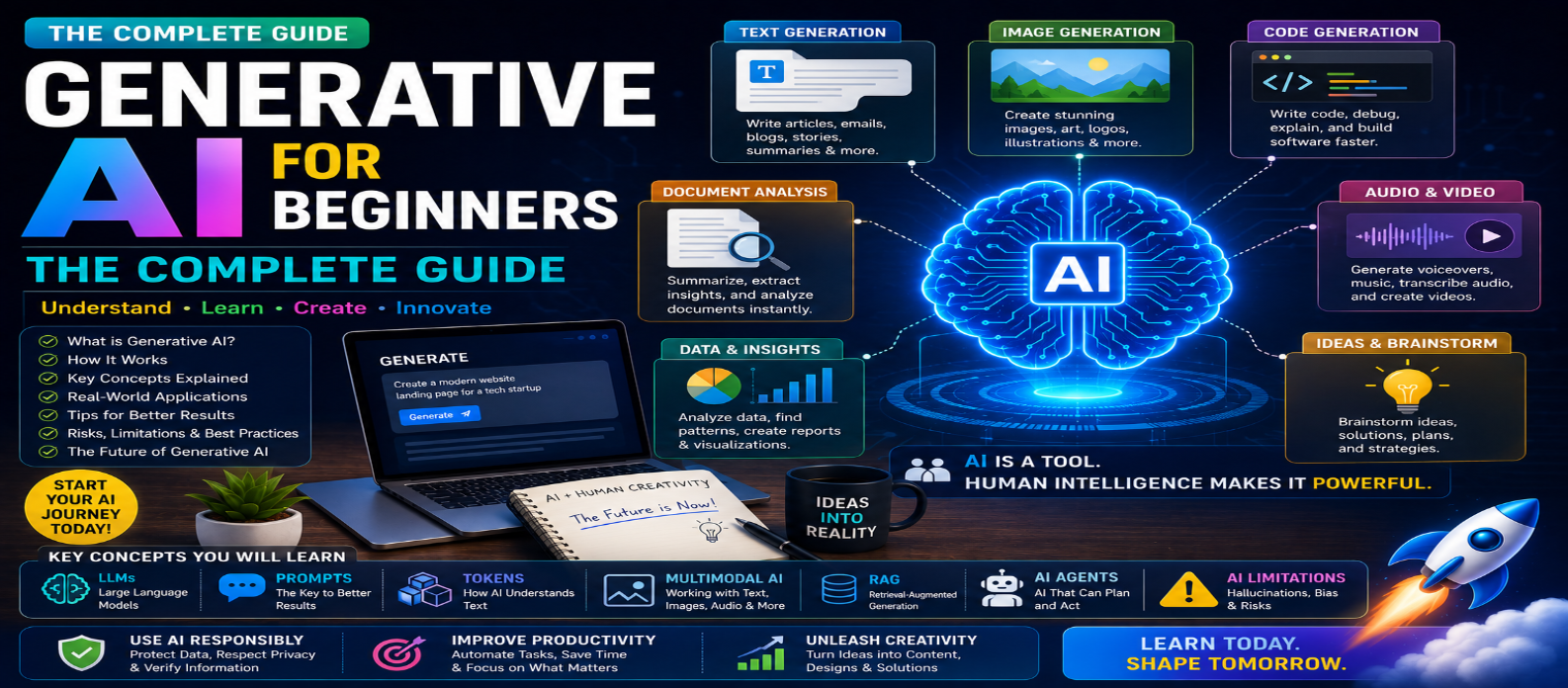
"Learn generative AI from the ground up with this complete beginner's guide for 2026. Understand how generative AI works, LLMs, prompts, tokens, multimodal AI, RAG, AI agents, hallucinations, benefits, risks, and practical everyday uses."
Generative AI for Beginners: The Complete Guide
Generative AI has become one of the most influential technologies of the modern digital world. In 2026, people are using generative AI to write content, create images, generate code, analyze documents, produce audio and video, brainstorm ideas, automate work, and build AI-powered applications.
For beginners, terms such as large language models, prompts, tokens, multimodal AI, and AI agents can sound complicated. But you don't need to be a programmer or data scientist to understand the basics.
This complete beginner's guide explains what generative AI is, how it works, what it can create, how to use it effectively, and what you should know before relying on AI-generated content.
What Is Generative AI?
Generative AI is a type of artificial intelligence designed to generate new content based on patterns learned from data.
Depending on the AI system, it can create:
- Text
- Images
- Code
- Audio
- Video
- Summaries
- Presentations
- Designs
- Structured data
For example, you could ask a generative AI system:
"Write a beginner-friendly explanation of cloud computing in 200 words."
The AI analyzes your instructions and generates a response based on patterns and information represented in its model.
Generative AI vs Traditional AI
Traditional AI systems are often designed to classify, predict, detect, or recommend.
For example:
Traditional AI: "Is this email spam?"
Generative AI: "Write a professional email replying to this customer."
The distinction isn't absolute, and modern AI systems can combine multiple capabilities. But generative AI is primarily associated with creating new outputs from user instructions and context.
How Does Generative AI Work?
Generative AI models are trained on large amounts of data and learn statistical patterns within that information.
When you provide a prompt, the model uses those learned patterns to generate an appropriate output.
A simplified process looks like:
Training Data → AI Model → User Prompt → Model Processing → Generated Output
The AI generally isn't searching through its training data for an exact stored answer. Instead, it generates output based on learned relationships and patterns.
What Is a Large Language Model?
A Large Language Model (LLM) is an AI model designed to work with language.
LLMs can perform tasks such as:
- Answering questions
- Writing
- Summarizing
- Translation
- Brainstorming
- Coding
- Information extraction
- Reasoning over provided information
Modern AI assistants often use LLMs as a major part of their underlying technology.
What Is a Prompt?
A prompt is the instruction or information you provide to a generative AI system.
A basic prompt might be:
"Write about digital marketing."
A better prompt would be:
"Write a 500-word beginner-friendly introduction to digital marketing for small business owners. Use clear headings, simple examples, and practical tips."
Better prompts provide the AI with more useful context.
A simple formula is:
Goal + Context + Requirements + Constraints + Format
What Are Tokens?
AI language models process text in smaller units commonly called tokens.
A token may represent a word, part of a word, punctuation, or another text unit depending on the model.
Tokens matter because AI systems can have limits on how much information they can process or generate at once, and some AI services calculate usage costs based partly on token consumption.
Beginners don't need to count every token manually, but understanding the concept helps when working with long documents or AI APIs.
What Is Multimodal AI?
Multimodal AI can work with more than one type of information.
Depending on the system, it may understand or generate combinations of:
Text + Images + Audio + Video + Documents
For example, you might upload an image and ask AI to explain what it contains, or provide written instructions and ask it to generate an image.
Multimodal capabilities are making AI assistants useful for a much wider range of tasks.
What Can Generative AI Be Used For?
Generative AI has applications across many industries and professions.
Writing and Content Creation
AI can help create:
- Blog drafts
- Emails
- Social posts
- Product descriptions
- Headlines
- Marketing copy
Human review remains important for accuracy, originality, tone, and quality.
Image Generation
Generative AI can turn written descriptions into images.
Common uses include:
- Blog covers
- Illustrations
- Concept art
- Marketing graphics
- Design inspiration
The more clearly you describe the subject, composition, mood, and style, the more control you can have over the result.
Coding
AI coding assistants can help developers:
- Generate code
- Debug errors
- Explain functions
- Write tests
- Refactor programs
- Create documentation
Generated code should always be tested and reviewed before production use.
Research and Learning
AI can help:
- Explain topics
- Summarize information
- Generate questions
- Compare concepts
- Organize research
- Create study plans
For factual research, verify important claims using trustworthy sources.
What Is Retrieval-Augmented Generation (RAG)?
AI models don't always contain the specific or current information required for a task.
Retrieval-Augmented Generation, commonly called RAG, combines information retrieval with generative AI.
A simplified workflow is:
Question → Retrieve Relevant Information → Provide Context to AI → Generate Answer
RAG can be useful for building AI assistants that work with company documents, product information, knowledge bases, manuals, or other specialized data.
What Are AI Agents?
AI agents take generative AI beyond simply responding to prompts.
An agent may be able to:
Understand Goal → Create Plan → Use Tools → Perform Actions → Evaluate Results
For example, an AI agent might research information, organize findings, create a document, and complete several connected steps.
As agents become more capable, permissions, security, monitoring, and human approval become increasingly important.
What Are AI Hallucinations?
Generative AI can sometimes produce information that sounds convincing but is incorrect or unsupported. This behavior is commonly called an AI hallucination.
AI may:
- Invent facts
- Misstate dates
- Generate nonexistent references
- Make calculation errors
- Misunderstand context
This is why important AI-generated information should be verified.
Never assume that confident wording means the information is correct.
How to Get Better Generative AI Results
Use these five principles:
- Be specific — Clearly explain what you need.
- Provide context — Give relevant background information.
- Set constraints — Specify length, tone, audience, or format.
- Ask follow-up questions — Improve the output iteratively.
- Verify important information — Don't blindly trust generated results.
AI works best as an interactive tool rather than a one-click answer machine.
Benefits of Generative AI
When used appropriately, generative AI can help people:
Save Time → Generate Ideas → Learn Faster → Automate Repetitive Work → Create Content → Analyze Information → Increase Productivity
It can also make certain technical capabilities more accessible to people without specialized expertise.
Risks and Limitations of Generative AI
Generative AI also has important limitations.
Users should consider:
- Incorrect information
- Bias
- Privacy
- Copyright
- Security
- Overreliance on automation
- Confidential-data exposure
- Misleading AI-generated media
Responsible AI use requires understanding both what the technology can do and where human judgment remains necessary.
How Beginners Should Start Using Generative AI
Start with simple tasks you already understand.
For example:
Summarize Text → Improve an Email → Brainstorm Ideas → Explain a Topic → Create an Outline
Once you're comfortable, move toward more advanced tasks involving documents, data, images, coding, research, automation, and AI agents.
This gradual approach helps you learn what AI does well and where you need to verify its output.
The Future of Generative AI
Generative AI is evolving from systems that primarily create text into multimodal assistants and agents capable of working across applications, information sources, and tools.
Future AI systems are likely to become more integrated into everyday software and professional workflows.
The most valuable skill may therefore not be memorizing every AI product. It will be learning how to communicate with AI, evaluate its output, protect information, and combine AI capabilities with human expertise.
Conclusion
Generative AI allows computers to create and transform content such as text, images, code, audio, video, and structured information based on user instructions and context.
For beginners, the key concepts are straightforward:
Prompt → AI Model → Generated Output → Human Review
Learn how prompts work, understand basic concepts such as LLMs, tokens, multimodal AI, RAG, and AI agents, and always verify important information.
Generative AI is powerful, but its greatest value comes when it is combined with human judgment, creativity, expertise, and responsible use.
Get a Free Access To 200+ Free Tools:
|
Home Page |
|
|
Calculator Tools |
|
|
Text & Converter Tools |
|
|
PDF & Image Tools |
|
|
Games & Developer Tools |
|
|
Resume Builder |