
Generative Engine Optimization (GEO): Complete Guide for 2026
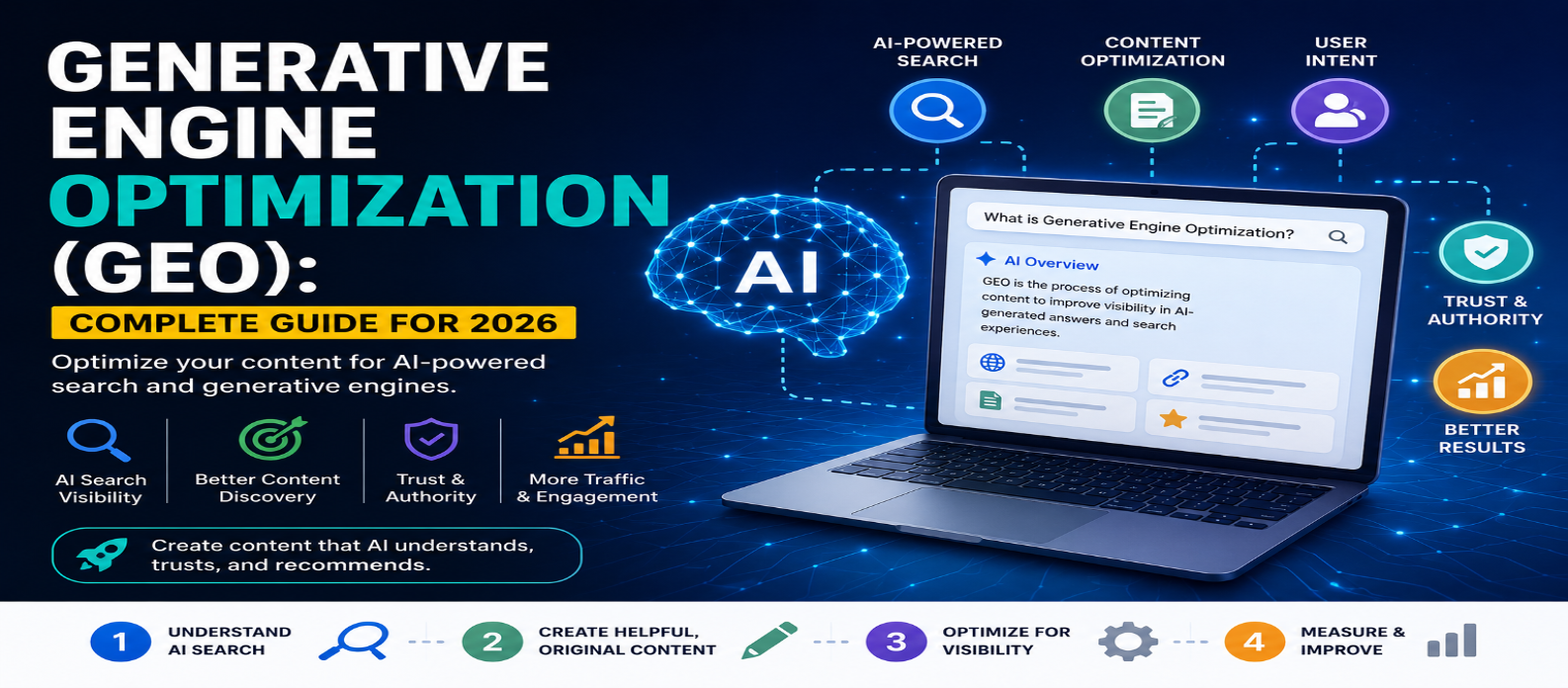
"Learn Generative Engine Optimization (GEO) for 2026, including how it differs from SEO and how to optimize content for AI search, citations, visibility, trust, and generative engines."
Generative Engine Optimization (GEO): Complete Guide for 2026
Search is expanding beyond traditional search-engine results. People increasingly use AI-powered search experiences, generative answer engines, and AI assistants to research topics, compare options, solve problems, and discover information.
This shift has introduced a term that website owners and marketers are hearing more often: Generative Engine Optimization (GEO).
GEO focuses on making your content useful and understandable in search experiences where artificial intelligence may retrieve information, synthesize answers, and surface supporting sources.
But GEO isn't a replacement for SEO, nor is it a collection of tricks for manipulating AI systems. The strongest GEO strategy begins with something familiar: create excellent content, make it technically accessible, establish trust, and provide information worth referencing.
Here's what website owners need to know in 2026.
What Is Generative Engine Optimization (GEO)?
Generative Engine Optimization (GEO) is the practice of improving digital content so it can be effectively discovered, understood, retrieved, and potentially surfaced within AI-generated search and answer experiences.
Traditional SEO primarily aims to improve visibility in search results.
GEO considers an additional journey:
User Question → AI Retrieves Information → Generates/Synthesizes Answer → Surfaces Sources
The objective isn't merely to "rank #1."
Your content may provide information that helps an AI-powered system answer a user's question while giving the user an opportunity to explore your website for more detail.
GEO vs SEO: What's the Difference?
GEO and SEO overlap significantly.
| SEO | GEO |
|---|---|
| Search-engine visibility | Generative-search visibility |
| Rankings and search features | AI answers and supporting sources |
| Keywords and search intent | Questions, entities and context |
| Crawlability and indexing | Retrieval and understanding |
| Organic clicks | Visibility, citations and clicks |
| Backlinks and authority | Trust and source usefulness |
The important point is that GEO doesn't make SEO obsolete.
A technically inaccessible page won't suddenly become successful simply because it was "optimized for AI."
Think of GEO as an extension of a strong search strategy.
How Generative Search Changes Content Discovery
Traditional search often works like:
Query → Results → Click → Read
Generative search can introduce:
Question → Retrieval → AI Summary → Sources → Follow-Up Question
Consider someone asking:
"What are the most effective ways to improve website speed without changing hosting?"
Instead of opening several results immediately, an AI system may synthesize relevant information first.
This changes the role of your website.
Your content needs to be useful not only as a destination but also as a clear, reliable information source.
1. Answer Specific Questions Clearly
Don't make readers search through several paragraphs for a basic answer.
If your heading asks:
What Is an XML Sitemap?
provide a direct explanation immediately underneath it.
Then expand with examples, limitations, and practical instructions.
A useful pattern is:
Question → Direct Answer → Explanation → Example → Action
This creates sections that are easy for readers to understand and useful in retrieval-based systems.
2. Focus on Topics, Not Just Exact Keywords
Traditional keyword research still has value, but generative search encourages a broader understanding of topics.
Suppose you're writing about:
Technical SEO
A complete article may naturally discuss:
Crawling → Indexing → Sitemaps → Robots Directives → Canonicals → Page Speed → Structured Data
These concepts help establish the context of the subject.
Don't artificially repeat "technical SEO" in every heading.
Write naturally and cover the information users actually need.
3. Create Information Worth Citing
This is one of the most important GEO principles.
Imagine 500 websites publish essentially the same definition of website optimization.
Why would an AI system—or a human—need another identical article?
Make your page more valuable with:
- Original examples
- Practical workflows
- First-hand testing
- Screenshots
- Original data
- Templates
- Calculators
- Interactive tools
- Detailed comparisons
- Troubleshooting information
For example, instead of simply saying:
"Large images can slow down a website."
show:
Original Image → Compression Process → New File Size → Visual Difference → Performance Impact
That turns general advice into useful evidence.
4. Use Clear Content Structure
Generative systems often retrieve specific passages rather than treating every webpage as one indivisible document.
Create logically organized sections using descriptive headings.
For example:
What Is GEO?
How Does GEO Work?
GEO vs SEO
How to Optimize Content for Generative Search
Common GEO Mistakes
Avoid vague headings such as "Important Things" or "More Information."
Every section should communicate a clear purpose.
5. Strengthen Entity and Context Clarity
Search systems need to understand what you're talking about.
Avoid ambiguous writing.
Instead of:
"It is useful for optimization."
write:
"Structured data can provide search engines with additional machine-readable information about certain types of page content."
Clear relationships between concepts, organizations, products, technologies, and people make information easier to interpret.
This doesn't mean awkwardly repeating names. Clarity should still sound natural.
6. Demonstrate Trust
Generative search increases the importance of source quality.
Make it clear who operates your website and, where relevant, who created the content.
Useful trust signals can include:
About Page → Author Information → Contact Details → Editorial Transparency → Accurate Sources → Updated Information
For topics requiring expertise, qualifications or real experience may also matter.
Never invent credentials simply to make content appear authoritative.
7. Keep Important Information Current
AI and technology topics can become outdated quickly.
A guide written in early 2026 might require significant updates later.
Periodically review important pages for:
- Outdated features
- Changed terminology
- Broken instructions
- Old screenshots
- Incorrect recommendations
Update the page when the underlying information changes.
Freshness should come from real updates, not simply changing the date.
8. Don't Ignore Technical SEO
GEO starts with accessibility.
Important pages should be:
- Crawlable
- Indexable
- Mobile-friendly
- Secure
- Internally linked
- Fast enough for a good experience
- Served with appropriate HTTP responses
Maintain clean canonicalization and XML sitemaps where appropriate.
If search systems cannot reliably discover or access your content, improving its wording for generative search won't solve the underlying problem.
9. Use Structured Data Where Appropriate
Structured data can provide additional context about certain page elements.
Depending on the website, it may describe:
- Articles
- Products
- Organizations
- Breadcrumbs
- Videos
- Events
Use markup that accurately matches visible content.
Avoid adding irrelevant schema simply because you believe it will increase AI visibility.
Structured data improves clarity; it doesn't guarantee AI citations.
10. Build Topic Clusters Without Creating Duplicate Articles
A website about web development might build:
Web Development
↳ Front-End Development
↳ JavaScript
↳ Website Performance
↳ Technical SEO
↳ AI Development
↳ AI Search
These related pages can support each other through natural internal linking.
However, avoid publishing:
"GEO Guide"
"Complete GEO Guide"
"GEO Optimization Guide"
"How to Do GEO"
if all four pages contain essentially the same information.
One authoritative resource is often more useful than several thin variations.
11. Optimize for Humans Before Generative Engines
Don't write strange sentences designed to "feed AI."
Avoid:
"GEO generative engine optimization AI search GEO strategy improves generative AI SEO."
That isn't optimization. It's keyword stuffing.
Instead:
"GEO helps website owners prepare content for search experiences that use generative AI."
Clear writing works better for readers and makes concepts easier for machines to interpret.
12. Measure More Than Rankings
GEO can make traditional measurement more complicated.
Don't focus exclusively on ranking position.
Monitor broader indicators such as:
Organic Impressions → Clicks → Branded Searches → Referral Traffic → Engagement → Conversions
If AI search increases awareness of your brand, some benefits may occur before a direct visit.
The ultimate goal isn't an AI citation by itself.
It's qualified visibility that creates business value.
A Practical GEO Checklist
Before publishing, ask:
✓ Does the page directly satisfy search intent?
✓ Are important questions clearly answered?
✓ Does it provide original value?
✓ Are headings descriptive?
✓ Are claims accurate?
✓ Is the author/site transparent?
✓ Can search engines access the page?
✓ Are related pages internally linked?
✓ Is structured data accurate where applicable?
✓ Would a human have a reason to visit after seeing an AI summary?
That final question is especially important.
GEO Mistakes to Avoid
Avoid treating GEO as a shortcut.
Common mistakes include:
- Mass-producing AI articles
- Creating near-duplicate pages
- Keyword stuffing
- Inventing research or statistics
- Publishing generic summaries
- Adding unnecessary structured data
- Writing exclusively for algorithms
- Ignoring traditional SEO
- Chasing every new AI-search acronym
The objective isn't to manipulate generative engines.
It's to become a source they—and more importantly, their users—can find useful.
Conclusion
Generative Engine Optimization reflects a major change in how online information is discovered.
Search is evolving from:
Find Pages → Read Pages
toward:
Ask Question → Retrieve Information → Generate Answer → Explore Sources
For website owners, the strongest GEO strategy is surprisingly straightforward:
Useful Content + Original Information + Clear Structure + Technical SEO + Trust + Topical Authority
SEO remains the foundation. GEO expands that foundation for an internet where AI increasingly participates in information discovery.
Don't optimize merely to be mentioned by an AI system.
Create content good enough to deserve being used, cited, explored, and remembered.
Get a Free Access To 200+ Free Tools:
|
Home Page |
|
|
Calculator Tools |
|
|
Text & Converter Tools |
|
|
PDF & Image Tools |
|
|
Games & Developer Tools |
|
|
Resume Builder |