
Google AI Overviews Explained: What Website Owners Need to Know in 2026
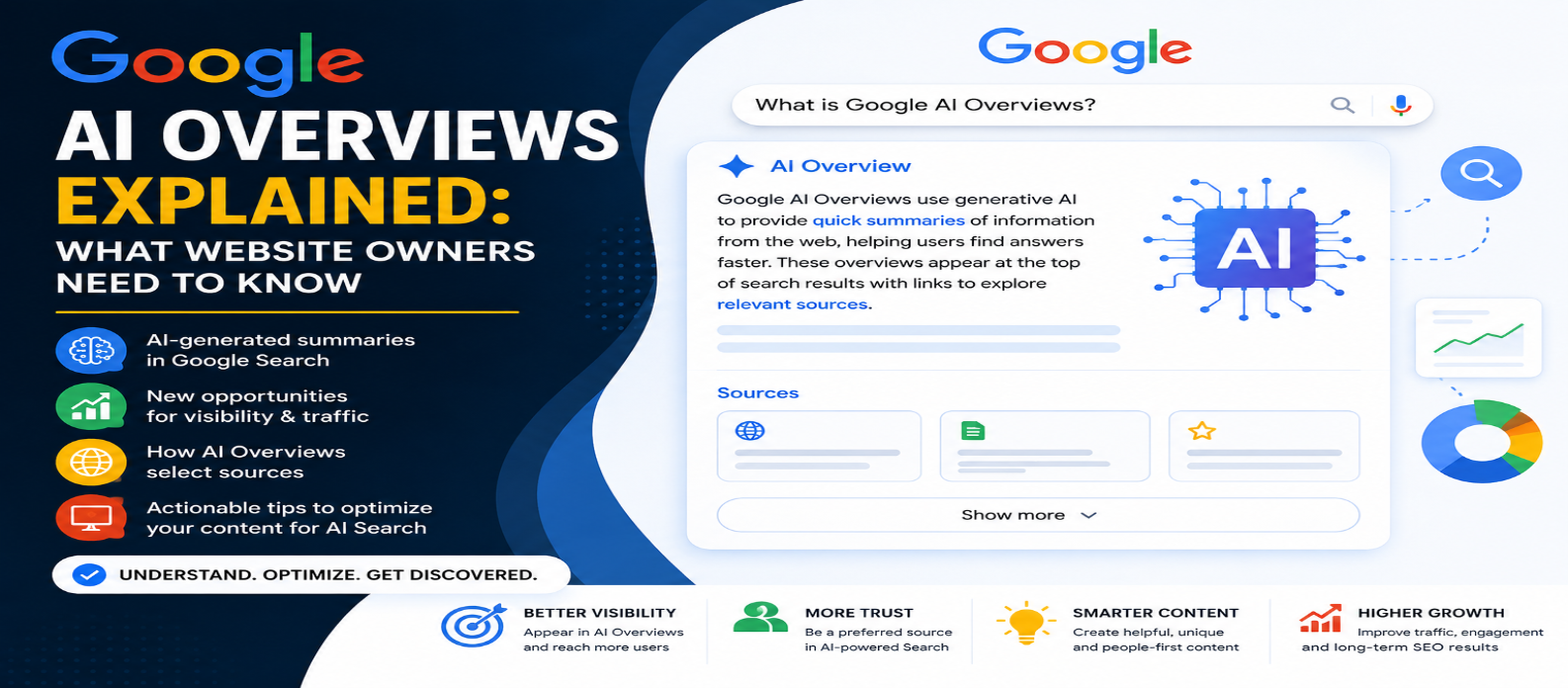
"Learn how Google AI Overviews work, how they affect website traffic and SEO, and what website owners can do to improve visibility in AI-powered Search."
Google AI Overviews Explained: What Website Owners Need to Know in 2026
Google Search is no longer just a page of traditional blue links. AI Overviews can provide AI-generated summaries directly within search results, helping users understand topics and explore relevant sources without manually opening numerous pages first.
For website owners, this creates both a challenge and an opportunity. Search visibility is no longer only about achieving a traditional organic ranking. Your content may also be discovered through Google's AI-powered search experiences.
In 2026, AI Overviews have become a major part of Google Search, with Google reporting more than 2.5 billion monthly active users.
So, what exactly are AI Overviews, and what should website owners do about them?
What Are Google AI Overviews?
Google AI Overviews are AI-generated responses that can appear in Google Search for certain queries.
Rather than simply displaying a list of results, Google can use generative AI alongside its search and ranking systems to organize information into an overview while providing links that allow users to explore relevant websites.
A simplified experience looks like:
Search Query → AI Overview → Supporting Websites → Traditional Results
AI Overviews are particularly useful for questions where users may otherwise need to perform multiple searches to understand a subject.
How Do AI Overviews Work?
AI Overviews aren't simply a chatbot placed above search results.
Google has explained that the system combines generative AI with its existing search and ranking infrastructure to identify relevant information from the web.
In simple terms:
User Question → Google Understands Intent → Finds Relevant Information → AI Organizes Information → Overview + Website Links
The exact presentation varies depending on the query.
In 2026, Google also made the experience more conversational, allowing users to move from an AI Overview into follow-up questions.
Why AI Overviews Matter for Website Owners
Previously, a common SEO objective was straightforward:
Rank Higher → Earn More Visibility → Receive More Clicks
AI Overviews add another layer.
Your website could potentially appear as a supporting source or link within an AI-generated search experience.
That means publishers should think about both:
Traditional Organic Visibility + Visibility Within AI Search Experiences
Google has also been increasing inline links and website previews within its generative search experiences to encourage users to explore original sources.
Will AI Overviews Reduce Website Traffic?
This is one of the biggest concerns for publishers.
The answer depends heavily on the query.
For a simple question such as:
"What does CSS stand for?"
an AI-generated answer may provide enough information that the user doesn't need another page.
But consider:
"How can I improve my website's Core Web Vitals without redesigning the entire site?"
The user may want detailed instructions, screenshots, examples, tools, testing procedures, or troubleshooting information.
That's where websites can provide considerably more value than a short overview.
The practical lesson is simple:
Don't create pages that provide nothing beyond a basic answer.
Create something worth visiting.
SEO Still Matters
AI Overviews haven't made SEO obsolete.
Google's current guidance says existing SEO fundamentals continue to apply to its generative AI search features.
Website owners should continue focusing on:
- Crawlable pages
- Useful original content
- Internal linking
- Descriptive titles
- Good page experience
- Mobile usability
- Relevant images and videos
- Structured data where appropriate
- Up-to-date information
You don't need to abandon traditional SEO and build an entirely separate website for AI search.
Create Content That Goes Beyond Commodity Information
This is becoming especially important.
Suppose hundreds of websites publish:
"10 Ways to Make a Website Faster."
If every article repeats the same advice—compress images, enable caching, reduce JavaScript—the web gains little new information.
A stronger article might contain:
Before/After Test → Screenshot → Exact Change Made → Performance Difference → What Didn't Work → Practical Recommendation
That's information users have a reason to visit the website to see.
Google's 2026 guidance for generative AI search specifically emphasizes providing unique, non-commodity content rather than simply reproducing information already widely available.
Answer the Main Question Clearly
Originality doesn't mean making articles unnecessarily complicated.
If someone searches:
"What is an AI API?"
give them a clear answer early in the article.
Then provide additional value through:
Examples → Explanations → Practical Steps → Comparisons → Common Problems
Don't force readers to scroll through hundreds of words before reaching the information promised by the title.
Make Your Content Easy to Understand
Clear structure benefits both readers and search systems.
For example:
H1: How to Improve Website Speed
H2: Why Website Speed Matters
H2: How to Test Your Website
H2: 10 Ways to Improve Speed
H3: Compress Images
H3: Reduce JavaScript
H2: Common Mistakes
This is much easier to navigate than one enormous block of text.
Use descriptive headings because they improve usability—not simply because you want to insert keywords.
Add First-Hand Value Where Possible
Website owners have something AI-generated summaries cannot automatically replace: their own experience and evidence.
Depending on your subject, this could include:
- Original screenshots
- Real tests
- Case studies
- Custom tools
- Original research
- Data
- Personal observations
- Templates
- Calculators
- Demonstrations
For a web-tools website, for example, an image-compression tutorial becomes more useful when readers can immediately use an actual compression tool and see the results themselves.
Build Topic Authority Instead of Random Articles
A strong website should help visitors continue learning.
Suppose your main subject is web development.
You could build connected resources around:
Web Development → HTML → CSS → JavaScript → Performance → Technical SEO → AI Development
Relevant internal links help visitors discover deeper information and make your website easier to navigate.
Avoid creating dozens of nearly identical articles simply to target slightly different keyword variations.
What About AEO and GEO?
You may encounter terms such as:
AEO — Answer Engine Optimization
and
GEO — Generative Engine Optimization
These describe ideas around optimizing content for answer engines and generative AI systems.
However, website owners shouldn't assume they need a collection of secret AI-specific optimization tricks.
Google's 2026 documentation specifically reinforces that established SEO best practices remain relevant for its generative AI search experiences.
Think less about:
"How do I trick AI into mentioning my website?"
and more about:
"How do I make this page one of the most useful resources for this question?"
Can You Track AI Overview Performance?
AI Overviews aren't completely separate from Search Console reporting.
Google has clarified that AI Overview impressions, clicks and position are included within Search Console's Performance reporting methodology, similar to other search-result features.
Website owners should therefore continue monitoring:
Impressions → Clicks → Queries → Pages → CTR → Position
Don't judge success solely by ranking position. Look at whether important pages are actually attracting relevant visitors.
Preferred Sources Create Another Opportunity
Google has also expanded Preferred Sources into AI Overviews and AI Mode.
When users select a publication as a preferred source, its content can be highlighted with a preferred badge within supported Google Search experiences.
For websites with loyal readers, building a recognizable brand and returning audience may therefore become even more valuable.
AI Overviews SEO Checklist for Website Owners
Before publishing an important article, ask:
Does it answer the search intent?
Does it provide something beyond generic information?
Is the information accurate and current?
Is the structure easy to understand?
Does it contain useful examples or evidence where appropriate?
Can Google crawl and index it properly?
Would someone still have a reason to visit this page after reading a short AI summary?
That final question is particularly useful.
The Future: Search Is Becoming a Conversation
Google Search is increasingly moving beyond individual keyword queries.
Users can ask complex questions and continue with follow-ups, while Google's AI search features help organize information and connect users with relevant websites.
For website owners, this means optimizing solely around exact keywords becomes less compelling.
Understanding questions, problems, intent, context and usefulness becomes more important.
Conclusion
Google AI Overviews represent an important change in how information is discovered through Search.
But the fundamental goal for website owners hasn't changed:
Create something people genuinely want to find.
Technical SEO remains important, but content needs to provide more than information that can be summarized in two sentences.
The strongest approach for 2026 is:
Useful Content + Original Value + Clear Structure + Strong SEO + Real Experience = Better Search Visibility
Instead of trying to outsmart AI Overviews, create pages valuable enough that AI-powered search helps people discover your website rather than replace the need to visit it.
Get a Free Access To 200+ Free Tools:
|
Home Page |
|
|
Calculator Tools |
|
|
Text & Converter Tools |
|
|
PDF & Image Tools |
|
|
Games & Developer Tools |
|
|
Resume Builder |