
Google Ranking Factors: Complete Guide for 2026
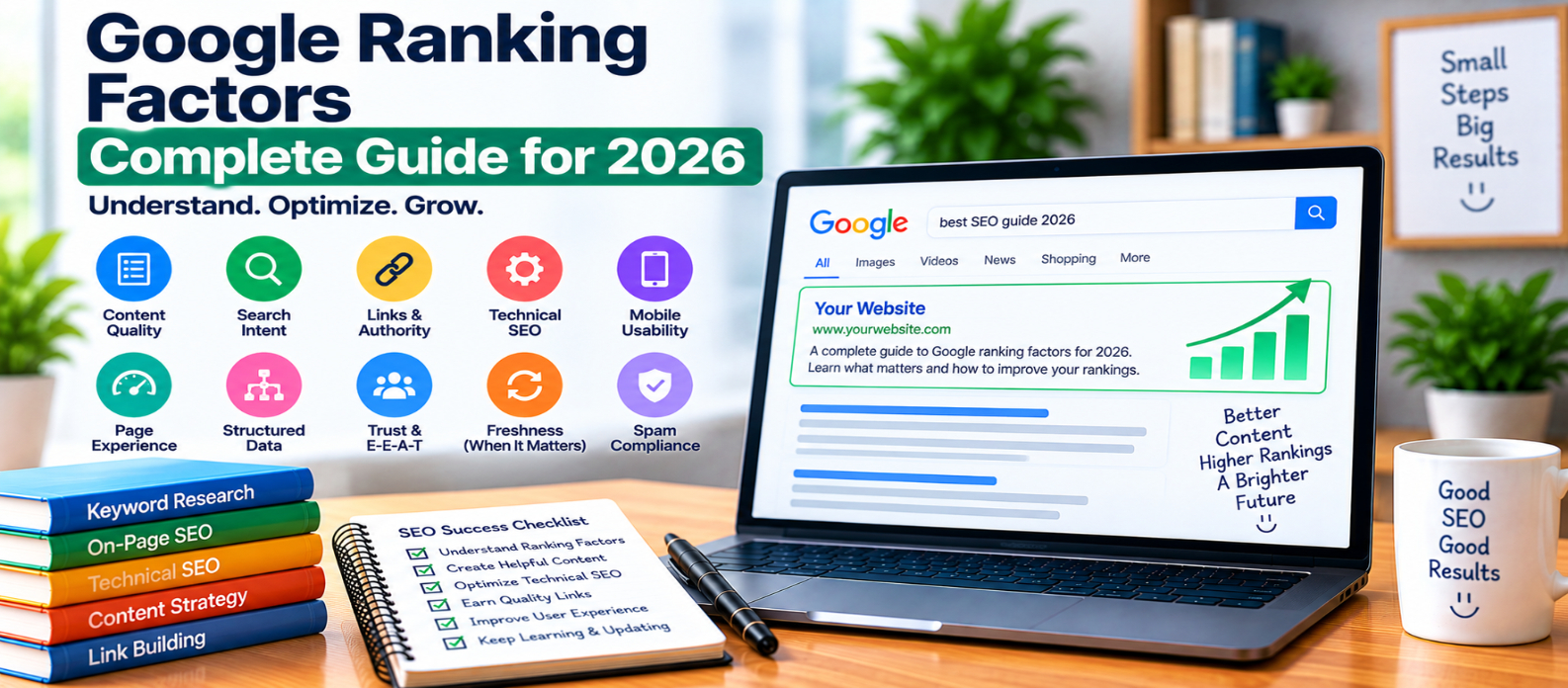
"Understand the major Google ranking factors and signals for 2026, including relevance, search intent, helpful content, links, technical SEO, page experience, mobile usability, Core Web Vitals, structured data, freshness, trust, and spam compliance."
Google Ranking Factors: Complete Guide for 2026
Why does one page appear above another in Google?
There isn't a single ranking factor—or a public formula you can follow to guarantee a position. Google uses multiple systems and signals to determine which results are relevant and useful for a particular search.
For website owners, the practical goal isn't to reverse-engineer every signal. It is to understand the major areas that can affect search visibility and build a website that performs well across them.
1. Relevance to the Search
A page needs to be relevant to what someone searched for.
Suppose the query is:
how to compress images for a websiteA useful page might explain:
- Image compression
- File size
- Image dimensions
- Suitable formats
- Quality trade-offs
- Practical optimization steps
Simply repeating the exact query many times doesn't make the page more relevant.
Cover the subject naturally and answer the actual need behind the search.
2. Search Intent
Two similar keywords can require completely different pages.
Consider:
"what is JSON"
→ informational explanation

"JSON formatter"
→ working tool

"JSON vs XML"
→ comparison
A detailed article may be excellent content but still be a poor match when the searcher primarily wants an interactive tool.
Before optimizing a page, determine what task the visitor wants to complete.
3. Helpful, Substantial Content
Content should provide enough value to accomplish its purpose.
For a technical tutorial, that could mean:
Clear Answer
    ↓
Explanation
    ↓
Working Example
    ↓
Common Problems
    ↓
Practical Solution
Don't make articles longer solely because you believe longer content ranks better.
A 700-word article that completely answers a focused question can be more useful than a 3,000-word article containing extensive filler.
4. Original Value
Rewriting information already available everywhere without adding anything useful gives people little reason to choose your page.
Original value can come from:
- Clearer explanations
- Working examples
- Original diagrams
- Useful tools
- Calculators
- Templates
- First-hand testing when genuinely performed
- Original research when you actually have the data
Never invent experience, statistics, research, or testing merely to make content appear more authoritative.
5. Links and Authority Signals
Links remain an important part of how the web is connected and how search systems understand pages.
However, not every backlink is equally useful.
A natural reference from a relevant page exists for a different reason than thousands of automatically generated links created only to manipulate rankings.
Create resources people have a legitimate reason to reference.
Avoid buying ranking links, automated link schemes, excessive exchanges, or other manipulative practices.
6. Internal Links
Your own links also help establish relationships between pages.
For example:
Technical SEO
     ↓
Crawling
     ↓
Indexing
     ↓
XML Sitemaps
     ↓
Canonical URLs
Use internal links where another page genuinely helps the visitor.
Important pages should not be buried deep within the website or left completely orphaned.
7. Crawlability and Indexability
A brilliant page cannot perform normally in search if Google cannot properly access or index it.
Technical problems can include:
- Accidental
noindex - Incorrect
robots.txtrules - Server errors
- Broken redirects
- Incorrect canonical URLs
- Poor internal discovery
For example:
<meta name="robots" content="noindex">can prevent a page from being indexed.
Technical SEO creates the foundation on which other optimization depends.
8. Page Experience
A page should work well for the person using it.
Consider:
- Loading performance
- Mobile usability
- HTTPS
- Visual stability
- Responsiveness
- Intrusive interruptions
- Navigation
Core Web Vitals can help measure important aspects of real-world page experience, but don't treat a perfect performance score as a guaranteed ranking shortcut.
A fast page with poor content doesn't automatically become the best search result.
9. Mobile Usability
Many searches happen on mobile devices, so pages need to work properly on smaller screens.
Check:
- Readable text
- Responsive layouts
- Usable navigation
- Appropriately sized images
- Touch-friendly controls
- Tables and code blocks
- Forms and interactive tools
Don't merely shrink a desktop layout. Make sure the page remains genuinely usable.
10. Titles and Main Headings
A descriptive title helps communicate what the page is about.
Compare:
Vague:
Everything You Need to Succeed Online
Clear:
How to Improve Website Loading Speed
The second communicates the subject immediately.
Write titles for clarity and relevance rather than stuffing several keyword variations into them.
11. Content Freshness—When It Matters
Not every page needs constant updating.
A query about current software features may benefit from recent information, while a basic explanation of binary numbers may remain useful for years.
Update pages when:
- Information changes
- Instructions become outdated
- Features disappear
- Better examples are available
- Important information is missing
Don't change dates simply to create artificial freshness.
12. Structured Data and Search Appearance
Correct structured data can help Google understand specific information on eligible pages and may make certain pages eligible for enhanced search appearances.
However:
Structured Data
      ≠
Guaranteed Higher Ranking
Use markup that accurately represents visible page content.
Don't add irrelevant schema simply because you hope it will improve rankings.
13. Spam Compliance
SEO tactics designed primarily to manipulate rankings can work against long-term visibility.
Problematic practices can include:
- Keyword stuffing
- Cloaking
- Link spam
- Doorway pages
- Scraped content
- Hidden text used manipulatively
- Large-scale low-value content created primarily to influence rankings
Automation or AI itself isn't the central issue. Creating large amounts of low-value content primarily to manipulate search rankings is.
What About E-E-A-T?
Experience, expertise, authoritativeness, and trustworthiness are useful concepts when evaluating content quality.
Instead of treating E-E-A-T as four switches you can turn on, ask practical questions:
- Is the information accurate?
- Is authorship clear where relevant?
- Are claims supportable?
- Does the page demonstrate genuine knowledge?
- Can visitors understand who operates the website?
- Is first-hand experience genuine when claimed?
Trust should be demonstrated rather than manufactured.
Google Ranking Checklist for 2026
Focus on:
-
Match the searcher's intent
-
Answer the query clearly
-
Provide substantial original value
-
Use descriptive titles and headings
-
Build useful internal connections
-
Keep important pages crawlable
-
Use correct canonical URLs
-
Provide a strong mobile experience
-
Improve real-world performance
-
Keep changing information accurate
-
Use structured data appropriately
-
Earn legitimate links and mentions
-
Avoid manipulative SEO practices
Conclusion
Google rankings shouldn't be approached as a checklist of mysterious switches.
Think of search visibility as the result of several layers working together:
Relevant to the Query
        ↓
Matches Search Intent
        ↓
Provides Genuine Value
        ↓
Technically Accessible
        ↓
Easy to Use
        ↓
Connected and Recognized
        ↓
Trusted Over Time
There is no single optimization that guarantees rankings.
Build pages that deserve to satisfy the search, make them technically easy to discover and understand, and improve them when real evidence shows something is missing.
That remains a more durable SEO strategy than chasing every rumored “ranking factor.”
Get a Free Access To 200+ Free Tools:
|
Home Page |
|
|
Calculator Tools |
|
|
Text & Converter Tools |
|
|
PDF & Image Tools |
|
|
Games & Developer Tools |
|
|
Resume Builder |