
How AI Is Changing Web Development in 2026
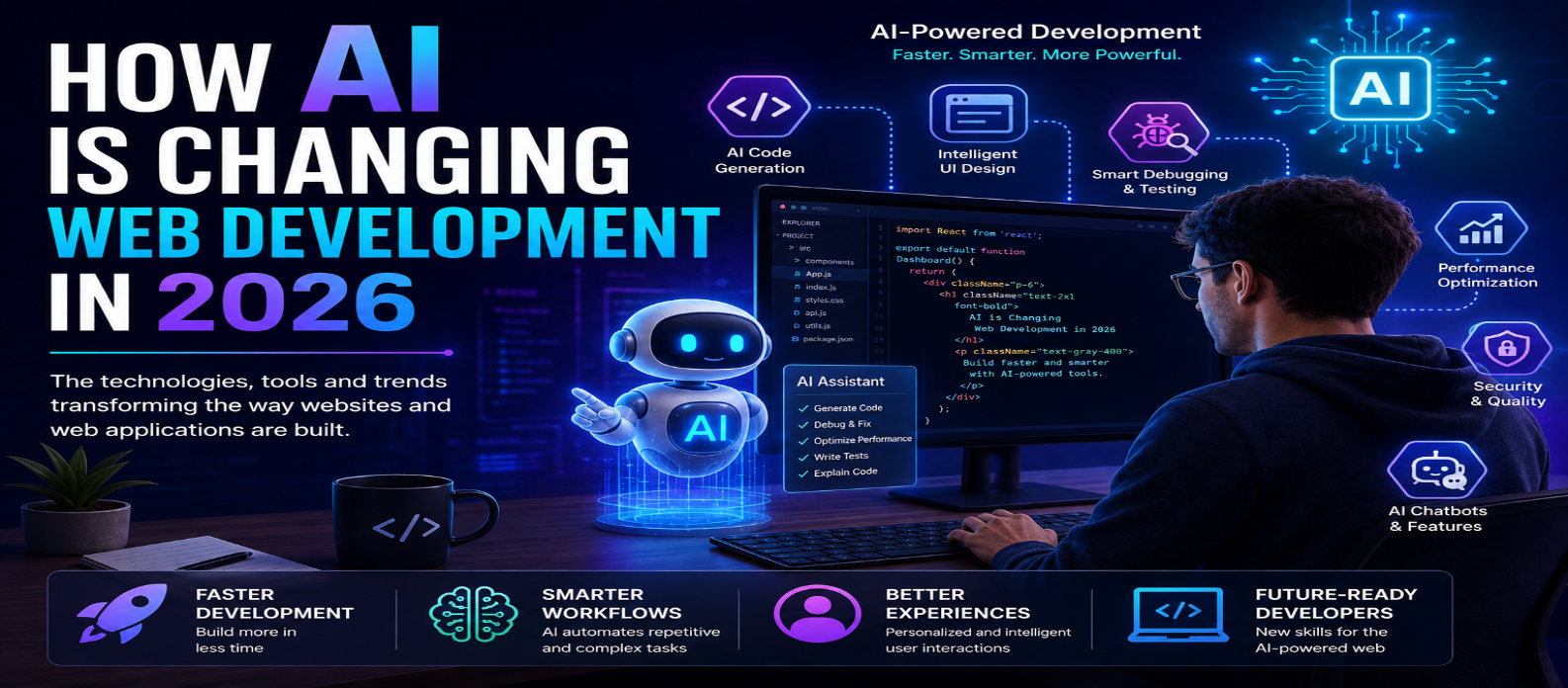
"Discover how artificial intelligence is transforming web development in 2026 through AI coding, intelligent design, automated testing, AI agents, browser-based AI, smarter websites, and new developer workflows."
How AI Is Changing Web Development in 2026
Artificial intelligence is rapidly changing how websites and web applications are planned, designed, coded, tested, optimized, and maintained. In 2026, AI is moving beyond simple code generation toward AI-assisted and agentic development, where AI systems can handle larger parts of a development workflow while developers provide direction, review, architecture, and quality control.
For developers, businesses, and website owners, understanding these changes is becoming essential. This guide explains how AI is transforming web development in 2026, the biggest trends to know, and what developers should learn next.
1. AI Is Making Coding Faster
One of the biggest changes is AI-assisted programming. Developers can describe a feature in natural language and use AI to generate code, explain existing code, identify bugs, refactor functions, and create documentation.
Instead of manually writing every component from scratch, developers can use AI to create a starting point and then review, test, and improve the result.
This is changing the development process from simply writing code to increasingly directing, reviewing, and validating code. Google has also highlighted this shift toward AI-assisted software engineering and the growing importance of human oversight.
2. AI Agents Are Changing Development Workflows
AI development is increasingly moving from chat-based assistance toward AI agents.
An AI agent can perform multiple related tasks, such as analyzing a codebase, making changes across files, running tests, identifying problems, and iterating on a solution.
Google's 2026 developer announcements describe this transition from AI that assists developers to agents that can independently navigate more complex workflows.
This means future developers may spend less time on repetitive implementation and more time defining requirements, architecture, constraints, security rules, and quality standards.
3. AI Is Transforming Website Design
AI can help developers and designers create:
- Website layouts
- Landing pages
- UI components
- Color and typography suggestions
- Responsive designs
- Content structures
- Design variations
This makes prototyping much faster. A website concept that previously required significant manual design work can now be turned into an interactive prototype much more quickly.
However, human designers still play an important role in usability, branding, accessibility, and creating experiences that make sense for real users.
4. AI Is Improving Debugging and Testing
Debugging is another area where AI can save considerable time.
AI tools can analyze error messages, inspect code, suggest possible fixes, generate test cases, and explain why a particular implementation may fail.
Developers can also use AI to review code for potential problems before deployment.
But AI-generated fixes should never be accepted blindly. AI can produce incorrect or insecure code, so developers must test and verify every important change.
5. AI Is Becoming Part of the Website Itself
AI isn't only changing how websites are built. It is also changing what websites can do.
Modern websites can incorporate:
- AI chatbots
- Intelligent search
- Product recommendations
- Personalized content
- Natural-language interfaces
- Document analysis
- Voice interactions
- AI-powered customer support
This creates websites that can respond more intelligently to individual users instead of simply displaying static information.
6. AI Is Changing Web Search and User Interaction
Search interfaces are becoming increasingly conversational, which means websites may need to consider how their content and functionality can be understood by AI systems as well as traditional search engines.
One notable development in 2026 is WebMCP, a proposed open web standard designed to allow browser-based AI agents to interact with structured website tools such as JavaScript functions and HTML forms.
This points toward a future where users may interact with websites through AI agents that can perform tasks rather than simply navigate pages manually.
7. AI Can Run Directly in the Browser
Web AI is also becoming more capable on the client side.
Google introduced LiteRT.js in 2026 to enable machine-learning inference directly in the browser, using technologies such as WebGPU, WebNN, and WebAssembly depending on the environment.
Browser-based AI can potentially reduce server dependence and enable new experiences involving intelligent interfaces, personalization, image processing, and other machine-learning features.
8. Developers Still Need Strong Fundamentals
AI makes development faster, but it does not eliminate the need for technical knowledge.
Developers still need to understand:
- HTML and CSS
- JavaScript or TypeScript
- Web architecture
- APIs
- Databases
- Security
- Accessibility
- Performance
- Testing
- Deployment
AI can generate code, but developers must understand whether that code is correct, secure, maintainable, and appropriate for the project.
This is especially important because AI tools may lack the complete architectural and business context of a production application.
9. AI Is Changing the Skills Employers Need
The role of a web developer is gradually expanding.
In addition to traditional programming, developers increasingly benefit from skills such as:
AI-assisted coding → Prompting and specification → Code review → AI API integration → Automation → Security → System architecture
The ability to clearly describe a problem, evaluate AI-generated solutions, and integrate those solutions into reliable applications can become just as important as writing code manually.
10. What Web Developers Should Learn in 2026
A strong learning path combines traditional web development with modern AI skills.
Start with HTML, CSS, JavaScript, Git, APIs, databases, and a frontend framework.
Then learn:
- AI APIs
- Large language models
- Retrieval-Augmented Generation (RAG)
- AI agents
- AI-assisted coding
- Web AI
- AI security
- Performance optimization
Keeping up with modern web-platform capabilities is also important. Google's Baseline initiative tracks browser support for newer web features, helping developers understand which capabilities are practical to use across modern browsers.
Will AI Replace Web Developers?
AI is unlikely to make web development expertise irrelevant. Instead, it is changing what developers spend their time doing.
Simple repetitive tasks may increasingly be automated, while architecture, problem solving, security, product understanding, testing, and human judgment remain essential.
The developers who learn to work effectively with AI may have an advantage over those who use either purely manual workflows or AI without understanding the underlying technology.
Conclusion
AI is transforming web development in 2026 from a code-only discipline into a more automated, intelligent, and agent-assisted workflow.
AI can accelerate coding, design, debugging, testing, content creation, and application development. At the same time, emerging technologies are making websites more capable of interacting with AI agents and running machine-learning workloads directly in the browser.
The best approach is not to choose between AI and traditional web development. Developers should learn both. Strong web fundamentals combined with effective AI tools, careful validation, and good engineering practices can help create faster, smarter, more secure, and more useful websites in 2026 and beyond.