
How to Optimize Your Website for AI Search: Complete Guide for 2026
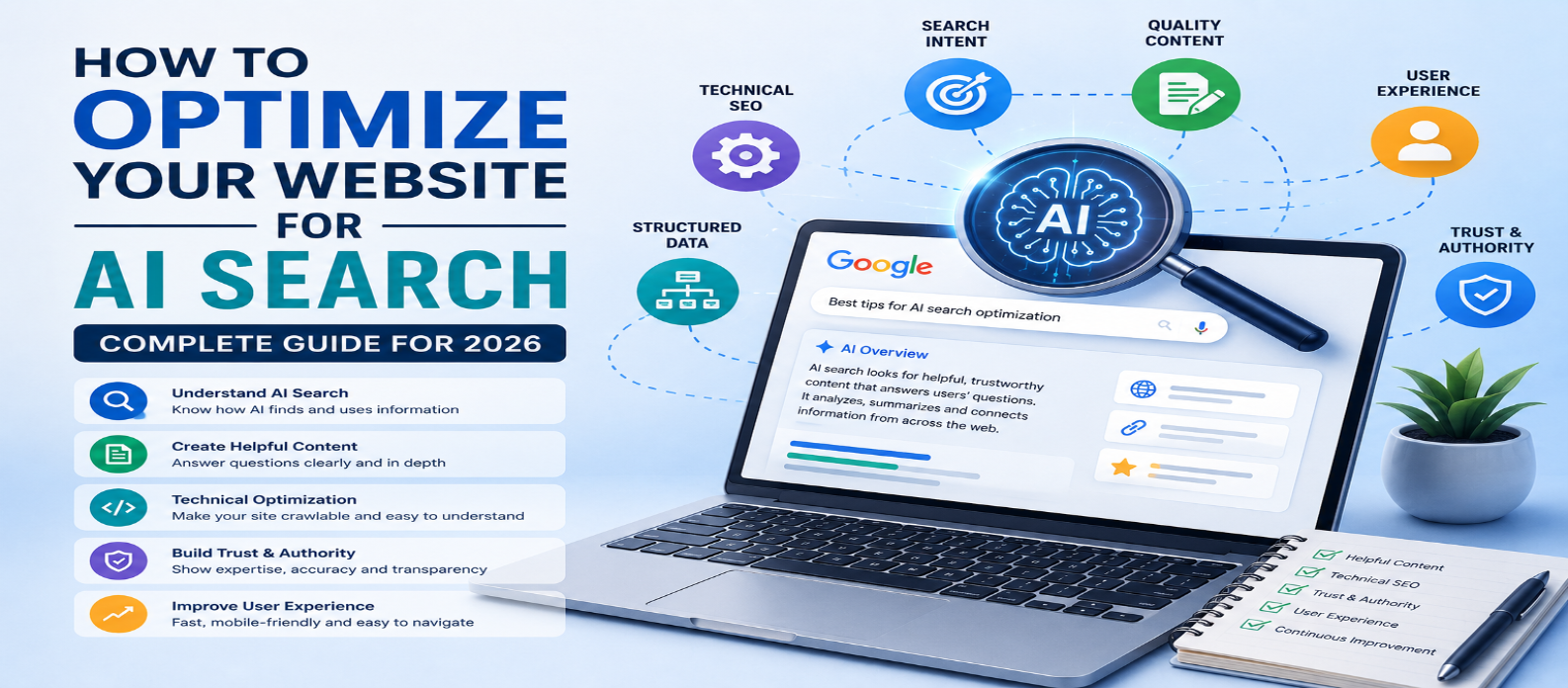
"Learn how to optimize your website for AI search in 2026 with practical strategies for content, search intent, technical SEO, structured data, trust, internal linking, and original value."
How to Optimize Your Website for AI Search in 2026
Search is evolving beyond traditional lists of links. AI-powered search experiences can now interpret complex questions, summarize information, compare sources, and help users explore topics conversationally.
For website owners, this creates an important question: How do you optimize a website for AI search?
The answer isn't to abandon traditional SEO or fill pages with AI-specific keywords. A stronger approach is to make your website easy to crawl, easy to understand, trustworthy, well-structured, and genuinely valuable enough to be referenced or visited.
This guide explains practical ways to optimize your website for AI search in 2026 without sacrificing traditional SEO.
What Is AI Search Optimization?
AI search optimization means improving your website so its content can be effectively discovered, understood, retrieved, and presented by search systems that use artificial intelligence.
Traditional SEO often follows:
Search Query → Ranked Results → Website Visit
AI-powered discovery can add another layer:
Question → Information Retrieval → AI-Generated Answer → Supporting Sources → Website Visit
The fundamentals still matter. Search systems generally need access to your pages before your content can become useful within search experiences.
1. Start With Search Intent, Not Keywords
Keywords remain useful, but understanding why someone is searching is more important than repeatedly using an exact phrase.
Suppose your target topic is:
"improve website speed"
Users might actually want to know:
- Why is my website slow?
- How can I test website speed?
- Which images are slowing my site?
- Does JavaScript affect loading speed?
- How can I improve mobile performance?
A strong article addresses the problem comprehensively instead of repeating "improve website speed" throughout the page.
Think:
Keyword → User Question → User Problem → Useful Answer
2. Give Clear Answers Early
AI-powered search systems frequently work with specific passages of information.
Don't hide the answer behind a long introduction.
For example, if your heading is:
What Is Technical SEO?
follow it with a straightforward explanation.
Technical SEO is the process of improving a website's technical structure so search engines can crawl, understand, index, and serve its pages effectively.
You can then provide deeper explanation.
This structure benefits both AI systems and human readers who want quick answers.
3. Structure Content Around Real Questions
Organize pages in a way that reflects how people naturally research a topic.
Instead of vague headings such as:
Introduction to Important Factors
use descriptive headings such as:
How Does AI Search Work?
Does Structured Data Help AI Search?
How Can I Make My Content Easier to Understand?
Does Traditional SEO Still Matter?
Clear headings create meaningful sections that can stand on their own while still contributing to the complete article.
4. Create Content AI Cannot Easily Replace
This may be the most important strategy.
If your article contains only information available on thousands of other websites, an AI-generated summary may satisfy the user's query without giving them much reason to visit your page.
Create something deeper.
Depending on your niche, that could include:
- Original screenshots
- Step-by-step demonstrations
- Templates
- Interactive tools
- Calculators
- Real examples
- Original research
- Experiments
- Comparison tables
- Troubleshooting instructions
For example, don't stop at:
"Compress images to improve website performance."
Show readers which images to check, what changes to make, how to measure the result, and what mistakes to avoid.
That's much harder to replace with a two-sentence summary.
5. Build Strong Topical Coverage
Publishing one isolated article on a broad subject rarely creates a complete resource.
Instead, build related content around a central topic.
For example:
Website SEO
could connect naturally with:
Technical SEO → Website Speed → Search Intent → Structured Data → Internal Linking → AI Search → Core Web Vitals
This helps visitors continue learning and gives your website deeper coverage of its main subjects.
However, avoid creating nearly identical pages just to target keyword variations.
These topics:
"How to Optimize for AI Search"
and
"10 Ways to Optimize Your Website for AI Search"
might be better as one comprehensive page rather than two repetitive articles.
6. Strengthen Internal Linking
Internal links help users and search engines discover relationships between your pages.
For example, an article about AI search could naturally reference another page explaining:
Technical SEO, AI Overviews, or website architecture.
Use descriptive anchor text.
Better:
Learn how technical SEO affects website crawling
Less useful:
Click here
Don't add internal links simply to increase their number. Add them when another page genuinely helps the reader.
7. Make Your Website Crawlable
Great content can't perform well if search systems cannot access it properly.
Check important technical elements such as:
- Robots directives
- XML sitemap
- Canonical URLs
- Internal links
- HTTP status codes
- HTTPS
- Mobile usability
- Page rendering
Important pages should be accessible through normal site navigation rather than existing as isolated URLs.
8. Use Structured Data Correctly
Structured data can help search engines understand specific information about a page.
Depending on the content, structured data may describe things such as:
- Articles
- Products
- Organizations
- Breadcrumbs
- Events
- Videos
Use only markup that accurately represents content visible on the page.
Structured data isn't a magic switch that guarantees inclusion in AI-generated answers.
Think of it as additional machine-readable context, not an AI-ranking shortcut.
9. Show Who Is Behind the Content
Trust becomes increasingly important when users encounter information through both traditional and AI-powered search.
Where appropriate, provide:
Author → About Page → Website Purpose → Contact Information → Editorial Information
For specialist topics, explain why the author or organization is qualified to discuss the subject.
Don't manufacture expertise.
Real transparency is more valuable than generic claims such as "industry-leading experts."
10. Keep Information Accurate and Updated
AI-related topics change quickly.
An article written today may contain outdated product features or terminology months later.
Periodically review important pages and:
- Remove outdated claims
- Update screenshots
- Correct broken information
- Add meaningful developments
- Improve weak sections
Don't change publication dates merely to make old content appear new.
Update the content when there is something worth updating.
11. Optimize Images and Other Media
AI search is increasingly multimodal, so don't think only about written text.
For important images:
- Use descriptive alt text
- Provide useful surrounding context
- Compress large files
- Use appropriate dimensions
- Choose efficient formats
- Avoid putting essential information only inside images
Videos, diagrams, screenshots, and illustrations can make complex subjects easier to understand.
12. Don't Write for AI Bots
A common mistake is trying to make sentences sound as though they were specifically written for an AI system.
Avoid unnatural patterns such as:
"AI search optimization AI SEO optimization website AI ranking..."
That damages readability and creates keyword stuffing.
Write the clearest possible explanation for a human.
Good content structure naturally makes information easier for machines to process too.
13. Make Every Important Page Worth Clicking
Before publishing, ask one question:
If an AI system summarized the basic answer, would someone still have a reason to visit this page?
If the answer is no, improve it.
Add:
Depth → Evidence → Demonstration → Tool → Example → Unique Perspective
For a web-tools website, interactive functionality can be particularly valuable because an AI-generated answer cannot replace the experience of actually using a calculator, converter, generator, analyzer, or optimization tool.
14. Monitor Search Performance
Optimization shouldn't end when an article is published.
Watch how pages perform over time.
Pay attention to:
Impressions → Clicks → CTR → Queries → Landing Pages → Engagement → Conversions
A page receiving impressions but very few clicks may need a stronger title or better alignment with search intent.
A page receiving traffic but poor engagement may not be satisfying visitors.
Use actual performance data to decide what to improve.
AI Search Optimization Checklist
Before publishing an important page, check:
✓ Clear search intent
✓ Direct answers
✓ Descriptive headings
✓ Original value
✓ Useful examples
✓ Natural internal links
✓ Crawlable/indexable page
✓ Accurate structured data where relevant
✓ Author/site transparency
✓ Mobile-friendly design
✓ Optimized images
✓ Current information
You don't need a secret "AI SEO" formula.
What to Avoid
Don't attempt to optimize for AI search by:
- Mass-producing similar pages
- Copying competitors
- Keyword stuffing
- Creating fake expertise
- Inventing statistics
- Publishing unverified information
- Adding unnecessary schema
- Creating hundreds of thin AI-generated articles
- Writing primarily for algorithms
These tactics may increase the amount of content on your website without increasing its actual value.
Conclusion
Optimizing a website for AI search in 2026 isn't about finding a hidden trick that forces AI systems to recommend your pages.
It starts with making your website an excellent source of information.
Focus on:
Search Intent + Clear Answers + Original Value + Technical SEO + Trust + Strong Structure + Useful Media
Traditional SEO and AI search optimization are increasingly connected. Websites that are crawlable, well-organized, authoritative, useful, and genuinely worth visiting are better positioned for both.
The goal isn't simply to make AI understand your website.
Build a website that gives people a reason to choose it.
Get a Free Access To 200+ Free Tools:
|
Home Page |
|
|
Calculator Tools |
|
|
Text & Converter Tools |
|
|
PDF & Image Tools |
|
|
Games & Developer Tools |
|
|
Resume Builder |