How Web Development Affects SEO: Complete Guide
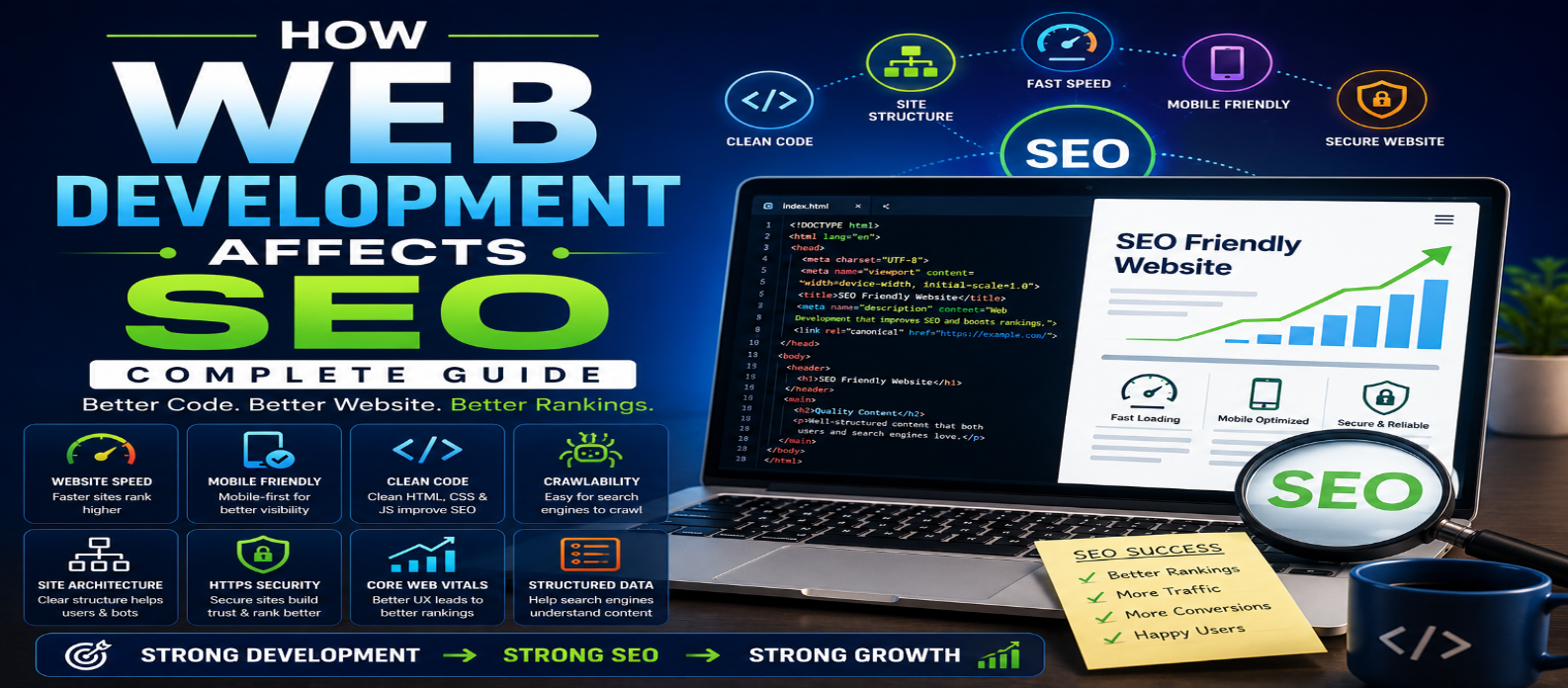
"Learn how web development affects SEO, including website speed, Core Web Vitals, mobile design, JavaScript, HTML structure, internal linking, URLs, security, structured data, and technical performance."
How Web Development Affects SEO: Complete Guide
Web development and SEO are closely connected. A website may have excellent content and strong keywords, but poor development practices can make it difficult for search engines to crawl, understand, index, and rank its pages.
Modern SEO is not only about content. Website speed, mobile responsiveness, HTML structure, JavaScript, internal linking, security, URL architecture, and technical performance can all influence search visibility and user experience.
This complete guide explains how web development affects SEO and what developers and website owners should optimize.
1. Website Speed Affects SEO Performance
Website speed is one of the most important areas where development and SEO overlap.
Slow websites can frustrate visitors and increase the likelihood that users leave before interacting with the page.
Developers can improve speed by:
- Compressing images
- Using modern image formats
- Minifying CSS and JavaScript
- Reducing unnecessary scripts
- Enabling browser caching
- Using a CDN
- Improving server response times
- Lazy-loading non-critical resources
A faster website generally provides a better user experience and creates a stronger technical foundation for SEO.
2. Core Web Vitals Matter
Core Web Vitals measure important aspects of real-world website experience.
The primary metrics include:
- LCP – Largest Contentful Paint: Loading performance
- INP – Interaction to Next Paint: Responsiveness
- CLS – Cumulative Layout Shift: Visual stability
Poor development practices such as oversized images, heavy JavaScript, unstable layouts, and slow servers can negatively affect these metrics.
Developers should test performance regularly and fix the largest bottlenecks first.
3. Mobile-Friendly Development Is Essential
Modern websites must work properly on smartphones, tablets, laptops, and desktops.
Responsive development should include:
- Flexible layouts
- Readable text
- Mobile-friendly navigation
- Proper viewport settings
- Responsive images
- Touch-friendly buttons
- Fast mobile performance
A website that performs poorly on mobile can create usability and search visibility problems.
4. HTML Structure Helps Search Engines Understand Content
Clean, semantic HTML makes webpages easier for browsers, users, and search engines to understand.
Developers should use:
- One clear primary heading where appropriate
- Logical heading hierarchy
- Semantic HTML elements
- Descriptive image alternative text
- Proper links
- Accessible forms
- Meaningful page structure
Avoid using excessive generic elements when semantic HTML can communicate the purpose of content more clearly.
5. JavaScript Can Affect Crawling and Indexing
JavaScript makes modern websites interactive, but excessive dependence on client-side rendering can sometimes create SEO challenges.
Important content, navigation, and links should be reliably available to search engines.
Developers should pay attention to:
- JavaScript-generated content
- Dynamic navigation
- Client-side routing
- Lazy-loaded content
- API-dependent pages
- Rendering errors
For content-focused websites, server-side rendering or pre-rendering can sometimes make important content easier to access.
6. Website Architecture Influences SEO
A well-organized website helps visitors and search engines find important pages.
A simple structure might look like:
Homepage → Category → Article
Avoid burying valuable pages several levels deep.
Good website architecture should provide:
- Logical categories
- Clear navigation
- Simple URLs
- Internal links
- Breadcrumbs
- Easy access to important content
A strong structure also makes your website easier to expand over time.
7. Internal Linking Helps Search Engines Discover Pages
Internal links connect related pages within your website.
For example:
Web Development → Website Speed → Core Web Vitals → Technical SEO
Good internal linking can help search engines discover new pages and understand relationships between topics.
Use descriptive anchor text instead of vague phrases such as "click here" whenever practical.
8. URL Structure Should Be Clean
Developers should create readable and consistent URLs.
A good URL might look like:
example.com/blog/how-web-development-affects-seo
Avoid unnecessarily complicated URLs containing long parameters, random characters, or confusing folder structures.
SEO-friendly URLs should generally be:
Short + Descriptive + Relevant + Easy to Read
9. HTTPS and Website Security Are Important
A modern website should use HTTPS to protect information transmitted between users and the server.
Developers should also follow security best practices involving:
- Authentication
- Input validation
- Secure cookies
- API protection
- Content Security Policy
- Software updates
- Secure hosting
A hacked or compromised website can damage user trust and create serious search visibility problems.
10. Canonical Tags Prevent Duplicate URL Problems
The same content can sometimes become accessible through multiple URLs.
For example, tracking parameters, filters, pagination, or application-generated URLs may create duplicate or similar pages.
Canonical tags help indicate the preferred URL.
Developers should ensure canonical URLs are consistent with:
- Internal links
- XML sitemaps
- Redirects
- Preferred domain settings
11. Redirects Must Be Implemented Properly
When a page permanently moves, developers should redirect users and search engines to the correct new URL.
Avoid:
- Redirect chains
- Redirect loops
- Redirecting everything to the homepage
- Leaving important old URLs broken
Clean redirect management protects both usability and accumulated search value.
12. XML Sitemaps Help With Discovery
An XML sitemap provides search engines with a list of important website URLs.
Developers should make sure the sitemap contains useful, indexable pages and is updated when content changes.
Avoid including broken, redirected, duplicate, or intentionally non-indexable URLs.
13. Structured Data Can Improve Search Understanding
Structured data provides additional machine-readable information about page content.
Depending on the website, structured data may describe:
- Articles
- Products
- Businesses
- Events
- Breadcrumbs
- Organizations
Structured data should accurately represent the visible content and should not be added simply to manipulate search results.
14. Accessibility Improves Website Quality
Good development should make websites usable by as many people as possible.
Important accessibility practices include:
- Semantic HTML
- Keyboard navigation
- Form labels
- Image alt text
- Clear focus states
- Readable content
- Sufficient contrast
Accessibility is valuable primarily because it improves usability and inclusiveness, while many accessibility practices also create cleaner, better-structured websites.
15. Server Reliability Matters
Search engines and visitors need to access your website consistently.
Frequent server errors, downtime, or extremely slow responses can create crawling and usability problems.
Choose reliable hosting and monitor:
- Uptime
- Server errors
- Response times
- Database performance
- Traffic spikes
Web Development SEO Checklist
Before launching a website, check:
Responsive Design → Fast Loading → Core Web Vitals → Semantic HTML → Crawlable Content → Clean URLs → HTTPS → Internal Links → Canonicals → Sitemap → Structured Data → Accessibility → Reliable Hosting
SEO should be considered throughout development instead of being added after the website is completed.
Conclusion
Web development can have a major impact on SEO because search engines need to efficiently crawl, render, understand, and index a website before its content can compete effectively in search results.
Fast loading times, mobile-friendly design, clean HTML, strong architecture, optimized JavaScript, HTTPS, internal linking, structured data, and reliable servers all contribute to a technically healthier website.
The best approach is to bring developers, content creators, designers, and SEO specialists together from the beginning.
When good content is supported by strong web development, a website has a much better foundation for delivering excellent user experiences and achieving long-term organic search growth.
Get a Free Access To 200+ Free Tools:
|
Home Page |
|
|
Calculator Tools |
|
|
Text & Converter Tools |
|
|
PDF & Image Tools |
|
|
Games & Developer Tools |
|
|
Resume Builder |