
JavaScript in 2026: The Complete Guide for Beginners and Developers
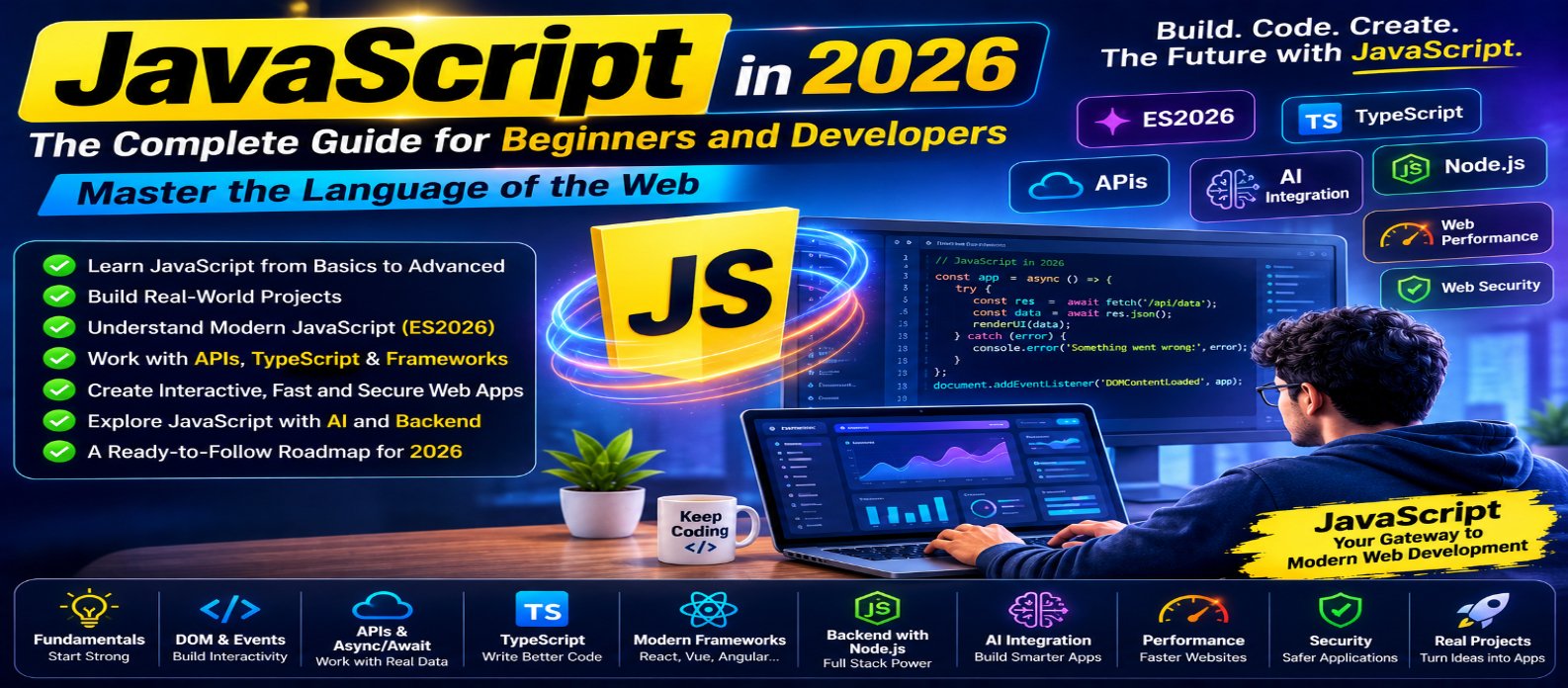
"Learn JavaScript in 2026 with this complete guide for beginners and developers, covering fundamentals, modern JavaScript, DOM, APIs, async programming, TypeScript, frameworks, backend development, security, performance, AI, and real-world projects."
JavaScript in 2026: The Complete Guide for Beginners and Developers
JavaScript remains one of the most important programming languages for web development in 2026. From simple interactive websites to complex web applications, servers, mobile apps, APIs, automation, and AI-powered experiences, JavaScript continues to play a central role in modern software development.
For beginners, JavaScript provides a practical path into programming. For experienced developers, the language continues to evolve alongside TypeScript, modern frameworks, Web APIs, server-side JavaScript, AI development tools, and increasingly powerful browser capabilities.
This complete guide covers what developers should know about JavaScript in 2026.
What Is JavaScript?
JavaScript is a programming language primarily used to make websites interactive and dynamic.
HTML creates the structure of a webpage, CSS controls its appearance, and JavaScript adds behavior.
In simple terms:
HTML = Structure → CSS = Design → JavaScript = Interactivity
JavaScript can power buttons, forms, animations, dynamic content, interactive dashboards, shopping carts, real-time updates, and complete web applications.
Why Learn JavaScript in 2026?
JavaScript remains valuable because it can be used across many areas of development.
Developers can use JavaScript for:
- Frontend development
- Backend development
- Web applications
- APIs
- Mobile applications
- Desktop applications
- Browser extensions
- Automation
- Serverless functions
- AI-powered applications
Learning JavaScript also makes it easier to understand many modern web frameworks and development tools.
1. Start With JavaScript Fundamentals
Beginners should first build a strong foundation.
Important concepts include:
- Variables
- Data types
- Operators
- Conditions
- Loops
- Functions
- Arrays
- Objects
- Classes
- Scope
- Error handling
Don't rush into frameworks before understanding these fundamentals. Frameworks change, but core programming concepts remain useful.
2. Learn Modern JavaScript Syntax
Modern JavaScript provides features that can make code cleaner and easier to maintain.
Developers should understand:
letandconst- Arrow functions
- Template literals
- Destructuring
- Spread and rest syntax
- Optional chaining
- Modules
- Promises
- Async/await
These features appear frequently in modern JavaScript projects.
3. Understand the DOM
The Document Object Model, or DOM, allows JavaScript to interact with webpages.
Using the DOM, developers can:
- Change text
- Modify styles
- Add or remove elements
- Respond to button clicks
- Validate forms
- Build interactive interfaces
DOM manipulation is one of the most important skills for beginners because it connects JavaScript programming with actual webpages.
4. Master Asynchronous JavaScript
Modern applications constantly communicate with servers and external services.
Developers should understand:
Promises → Async/Await → Fetch → APIs
Asynchronous programming allows an application to request data without freezing the entire interface while waiting for a response.
It is essential for applications involving APIs, databases, authentication, dashboards, and real-time services.
5. Learn APIs and JSON
Modern web applications rarely operate independently.
APIs allow JavaScript applications to communicate with other systems.
Developers should understand:
- HTTP requests
- GET and POST
- Status codes
- JSON
- Fetch API
- Headers
- Authentication
- Error handling
Once you understand APIs, you can build applications using external data and services.
6. Learn TypeScript
TypeScript adds a type system and additional development features on top of JavaScript.
It can be especially useful for larger applications because it helps developers identify certain errors earlier and makes complex codebases easier to understand.
Beginners should generally learn JavaScript fundamentals first and then move to TypeScript.
A useful path is:
JavaScript → Modern JavaScript → TypeScript
7. Choose a Frontend Framework
Once you understand JavaScript well, you can learn a modern frontend framework or library.
Common choices include:
- React
- Vue
- Angular
- Svelte
You don't need to learn all of them.
Choose one and focus on understanding components, state, routing, forms, data fetching, reusable interfaces, and application architecture.
8. JavaScript for Backend Development
JavaScript isn't limited to browsers.
Server-side JavaScript allows developers to build:
- APIs
- Authentication systems
- Web servers
- Real-time applications
- Database-driven applications
- Backend services
This makes it possible to use JavaScript across both the frontend and backend of a project.
9. JavaScript and AI Development
Artificial intelligence is changing JavaScript development in two major ways.
First, developers can use AI assistants for:
- Generating code
- Explaining code
- Debugging
- Writing tests
- Documentation
- Refactoring
- Learning new concepts
Second, JavaScript applications can integrate AI features such as:
- Chatbots
- AI search
- Recommendations
- Text generation
- Image analysis
- Document processing
- AI agents
JavaScript therefore remains highly relevant as AI becomes more deeply integrated into web applications.
10. Learn Testing and Debugging
Writing code is only part of professional development.
Developers should learn how to:
- Use browser developer tools
- Read error messages
- Set breakpoints
- Inspect network requests
- Test functions
- Write automated tests
- Handle unexpected errors
Strong debugging skills often matter more than memorizing syntax.
11. Focus on JavaScript Performance
Large amounts of JavaScript can negatively affect website performance.
Developers should learn techniques such as:
- Code splitting
- Lazy loading
- Tree shaking
- Reducing unnecessary dependencies
- Efficient event handling
- Minimizing expensive DOM operations
- Loading non-critical scripts efficiently
The goal should be to ship only the JavaScript users actually need.
12. Learn JavaScript Security
JavaScript developers should understand common security risks.
Important areas include:
- Cross-site scripting (XSS)
- Input validation
- Secure authentication
- Content Security Policy
- Safe DOM manipulation
- API security
- Dependency security
- Secure handling of sensitive data
Never place passwords, private API keys, or confidential server credentials inside browser-side JavaScript.
13. Explore Modern Browser APIs
Modern browsers provide powerful APIs that allow JavaScript to access capabilities beyond basic webpage manipulation.
Depending on browser support and permissions, these can include:
- Storage
- Notifications
- Clipboard
- Geolocation
- Media
- Graphics
- Web Workers
- Service Workers
- WebSockets
- WebAssembly integration
Understanding native Web APIs can sometimes eliminate the need for unnecessary third-party libraries.
14. Build Real JavaScript Projects
The fastest way to improve is to build projects.
Beginners can start with:
- Calculator
- To-do list
- Quiz application
- Weather application
- Expense tracker
- Notes application
- Interactive dashboard
- E-commerce interface
- REST API application
- AI-powered web application
Each project teaches practical problem-solving skills that tutorials alone cannot provide.
JavaScript Roadmap for 2026
A practical learning sequence is:
HTML & CSS → JavaScript Fundamentals → DOM → Modern JavaScript → Async/Await → APIs → Git → TypeScript → Framework → Backend → Databases → Testing → Performance → Security → AI Integration
Learn gradually and build projects throughout the process.
Is JavaScript Still Worth Learning in 2026?
Yes. JavaScript continues to be a core technology of the web and supports a broad ecosystem extending far beyond basic browser scripting.
AI may automate portions of coding, but developers still need to understand application logic, architecture, security, debugging, performance, and the code generated by AI systems.
The combination of JavaScript fundamentals + modern development skills + AI-assisted workflows can be especially valuable in 2026.
Conclusion
JavaScript in 2026 is much more than a language for adding simple interactions to webpages. It powers modern frontend applications, backend services, APIs, automation, and AI-enabled web experiences.
Beginners should focus on mastering the fundamentals before chasing frameworks. Experienced developers should continue developing skills in TypeScript, performance, security, modern Web APIs, testing, and AI integration.
The most effective path is simple:
Learn the fundamentals. Build real projects. Understand the web platform. Use AI intelligently. Keep improving.
Get a Free Access To 200+ Free Tools:
|
Home Page |
|
|
Calculator Tools |
|
|
Text & Converter Tools |
|
|
PDF & Image Tools |
|
|
Games & Developer Tools |
|
|
Resume Builder |