
Off-Page SEO: Complete Guide for Building Website Authority
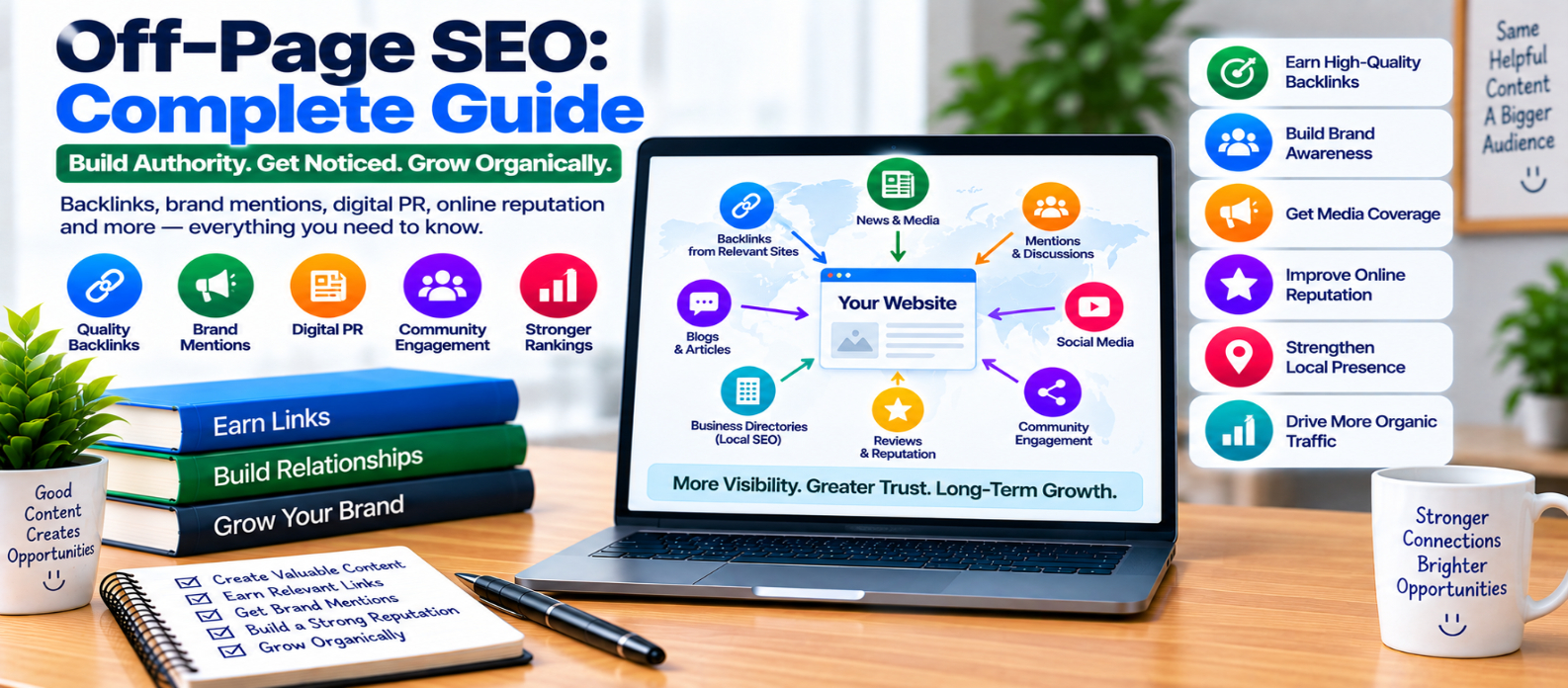
"Learn how off-page SEO works, including backlinks, link earning, brand mentions, digital PR, online reputation, local signals, community participation, backlink quality, and safe ways to build long-term website authority."
Off-Page SEO: Complete Guide
You can optimize your content, titles, internal links, and website structure perfectly, but search visibility isn't influenced only by what happens on your own pages.
Search engines can also use information from across the web to understand websites, pages, organizations, and their relationships.
This broader area is known as off-page SEO.
Off-page SEO includes activities and signals outside your website that can contribute to its visibility, discovery, reputation, and authority. Backlinks are an important part of it, but off-page SEO is much broader than simply collecting links.
What Is Off-Page SEO?
Off-page SEO refers to optimization efforts and external signals that occur away from your own website.
These may include:
Backlinks
    +
Brand Mentions
    +
Digital PR
    +
Online Reputation
    +
Relevant Community Exposure
The goal shouldn't be to manufacture signals that make a website appear more popular than it really is.
A sustainable strategy focuses on becoming useful enough to reference, discuss, recommend, and discover naturally.
On-Page SEO vs Off-Page SEO
The distinction is straightforward.
On-page SEO involves things you directly control on your pages:
- Content
- Titles
- Headings
- Images
- Internal links
- URLs
Off-page SEO involves signals and activity beyond your website:
- Links from other sites
- Independent mentions
- Media coverage
- Relevant citations
- Reputation
Both can support search visibility, but they require different strategies.
1. Understand Why Backlinks Matter
A backlink is a link from another website to yours.
For example:
Website A
    ↓
Links to useful research
    ↓
Website B
Links can help search engines discover pages and understand relationships across the web.
However, not every backlink has equal value.
A relevant editorial link placed because a resource genuinely helps readers is very different from thousands of automatically generated links on unrelated websites.
Focus on quality and relevance rather than raw link counts.
2. Create Content Worth Referencing
One of the strongest foundations for earning links is publishing something people have a reason to reference.
Examples include:
- Original tools
- Detailed tutorials
- Useful calculators
- Research
- Original datasets
- Practical templates
- Visual explanations
- Technical documentation
- Well-organized reference guides
Ask:
What does this page provide that makes another writer want to cite or recommend it?
Simply publishing another generic article may not create that reason.
3. Build Linkable Resources
Some content is naturally easier to reference than ordinary articles.
Imagine a website publishes a genuinely useful:
Website Speed Calculator
        ↓
Useful to Developers
        ↓
Referenced in Tutorials
        ↓
Natural Discovery & Links
Interactive tools can be particularly valuable because they solve a specific problem.
For a tools-focused website, useful functionality itself can become part of the off-page SEO strategy.
4. Use Digital PR Strategically
Digital PR involves creating information, resources, or stories that relevant publishers may genuinely find worth covering.
Examples might include:
- Original research
- New product or tool launches
- Useful industry data
- Interesting surveys
- Expert analysis
- Significant company developments
The objective isn't to send the same promotional message to hundreds of unrelated websites.
A good outreach question is:
Why would this specific audience care?
If there is no convincing answer, the pitch probably isn't relevant.
5. Pursue Relevant Mentions
Not every useful online mention must be approached as a link transaction.
People may discuss a website, tool, company, or resource without linking directly to it.
Independent mentions can still increase awareness and send people searching for your brand.
A healthy online presence develops through genuine usefulness and recognition rather than artificial placement.
6. Participate in Relevant Communities
Communities can help people discover useful expertise and resources.
This may include:
- Developer communities
- Professional discussions
- Industry groups
- Question-and-answer communities
- Relevant forums
But participation should add value.
Avoid:
Question
   ↓
Drop Your Link
   ↓
Leave
Instead:
Understand Question
       ↓
Provide Useful Answer
       ↓
Reference a Resource Only When Helpful
Community participation should work even when no backlink is gained.
7. Consider Local SEO Signals
For businesses serving specific geographic areas, off-page SEO can also involve local visibility.
Important areas may include:
- Accurate business information
- Relevant local citations
- Customer reviews
- Community mentions
- Local partnerships
Consistency matters. Incorrect business names, phone numbers, addresses, or duplicate profiles can confuse potential customers.
For websites without a local business component, these signals may be irrelevant.
8. Build a Genuine Reputation
Off-page SEO and reputation often overlap.
Before linking to or recommending a website, people may consider:
- Who operates it?
- Is the information reliable?
- Does the website provide real value?
- Is the organization transparent?
- Does the resource deserve a recommendation?
SEO cannot manufacture genuine credibility through technical tricks alone.
Make authorship, business information, contact methods, and relevant expertise clear where appropriate.
9. Avoid Buying Links for Rankings
Paying for links specifically to manipulate search rankings creates unnecessary risk.
Similarly, be cautious about:
- Large-scale link exchanges
- Automated backlink packages
- Private link networks
- Spam comments
- Low-quality directories
- Hidden links
- Mass-produced guest posts
- Links inserted into unrelated content
A promise such as:
"10,000 SEO backlinks instantly"
should not be confused with a sustainable authority strategy.
More links do not automatically mean better SEO.
10. Don't Obsess Over Third-Party Authority Scores
SEO platforms may calculate their own domain or page authority metrics.
These can sometimes help with competitive research, but they aren't the same thing as a Google ranking score.
Don't make the objective:
Increase Tool Score From 30 → 50Make it:
Create Better Resources
        ↓
Earn Relevant Recognition
        ↓
Attract Qualified Visitors
        ↓
Build Long-Term Visibility
Metrics should help evaluate strategy—not become the strategy.
11. Evaluate Backlink Quality
When reviewing a backlink, consider:
Relevance: Is the linking page related to your subject?
Context: Does the link naturally fit the discussion?
Editorial reason: Was it included because the destination is genuinely useful?
Traffic potential: Could interested readers realistically follow it?
Placement: Is it part of meaningful content rather than an unrelated collection of links?
A small number of genuinely relevant references can be more meaningful than a huge collection of artificial links.
12. Monitor Your Website's External Presence
Periodically review:
- New backlinks
- Lost important links
- Brand mentions
- Referral traffic
- Media coverage
- Local reviews where relevant
- Unusual spam patterns
Don't panic because random low-quality websites link to you. Websites generally cannot control every inbound link they receive.
Concentrate on your own practices and meaningful patterns.
Off-Page SEO Checklist
Use this checklist when developing your strategy:
-
Publish genuinely useful resources
-
Create content worth referencing
-
Develop useful tools where appropriate
-
Earn relevant editorial links
-
Pursue meaningful brand mentions
-
Use digital PR when you have something valuable to share
-
Participate constructively in relevant communities
-
Maintain accurate local information where applicable
-
Encourage genuine customer feedback appropriately
-
Monitor important backlinks
-
Track referral traffic
-
Avoid automated backlink schemes
-
Avoid manipulative link exchanges
-
Don't buy links for ranking manipulation
-
Measure real visibility rather than chasing vanity metrics
Conclusion
Off-page SEO isn't a competition to collect the largest number of backlinks.
A healthier model is:
Create Something Valuable
          ↓
People Discover It
          ↓
People Discuss or Reference It
          ↓
Reputation and Awareness Grow
          ↓
More Opportunities for Discovery
Build resources people genuinely want to use and reference. Promote them to relevant audiences, participate meaningfully in your industry, earn editorial recognition, and monitor how your website is discussed across the web.
The strongest off-page SEO signals are often the result of earning attention—not manufacturing it.
Get a Free Access To 200+ Free Tools:
|
Home Page |
|
|
Calculator Tools |
|
|
Text & Converter Tools |
|
|
PDF & Image Tools |
|
|
Games & Developer Tools |
|
|
Resume Builder |