
Search Intent Explained: Complete SEO Guide
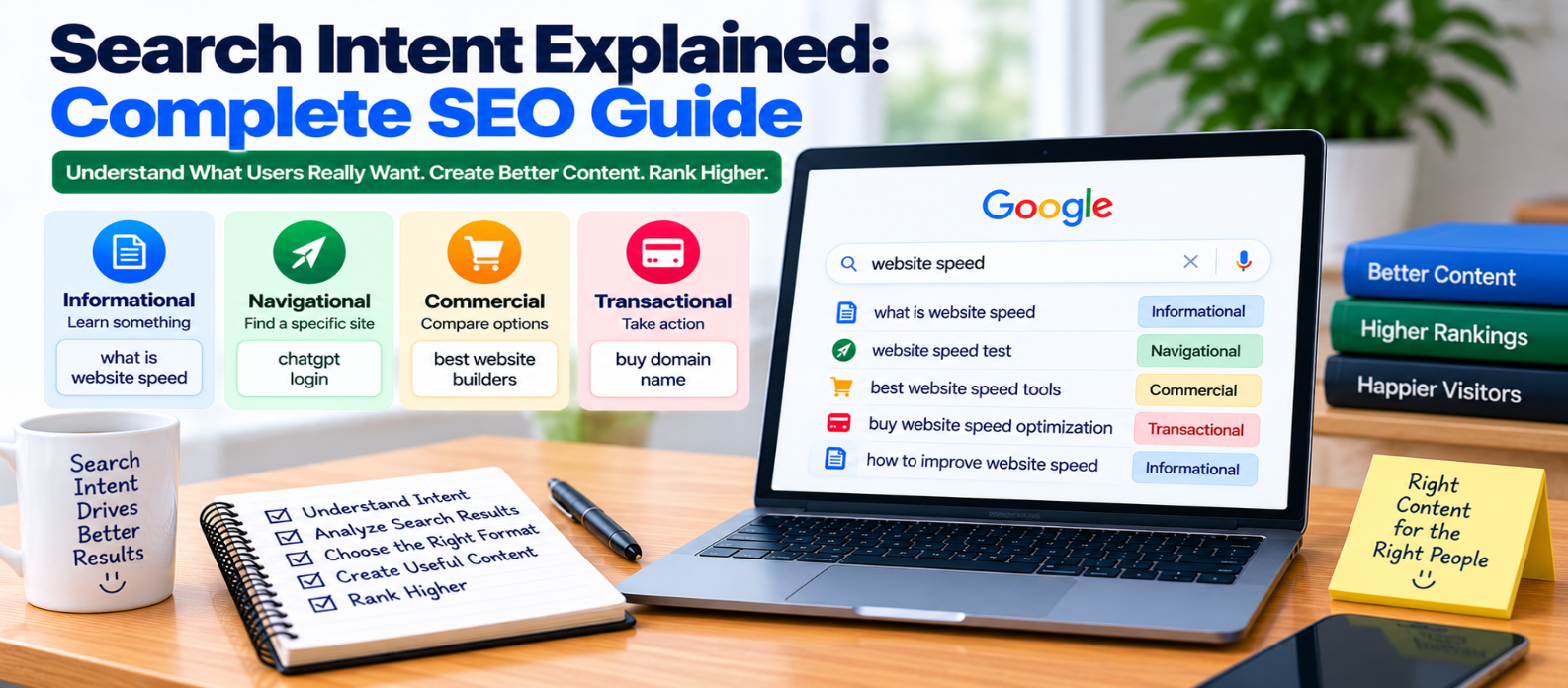
"Learn what search intent is, understand informational, navigational, commercial and transactional searches, analyze search results, identify the right content format, group keywords by intent, and create pages that better match what users actually want."
Search Intent Explained: Complete SEO Guide
Two people can search for closely related keywords while expecting completely different results.
Someone searching “what is image compression” probably wants an explanation. Someone searching “compress image online” likely wants a tool they can use immediately.
The words are related, but the search intent is different.
Understanding this difference is essential for SEO because ranking for a keyword isn't only about mentioning the right terms. Your page also needs to provide the kind of answer or experience the searcher is looking for.
What Is Search Intent?
Search intent—sometimes called user intent—is the purpose behind a search query.
In simple terms:
What is the person trying to accomplish?
Consider these searches:
what is a domain name
best domain registrar
buy a domain name
example registrar login
All involve domains, but the desired outcome differs.
One person wants information, another wants comparisons, another is ready to take action, and another wants a particular destination.
Recognizing these differences helps you create the right page for each need.
The Four Common Types of Search Intent
Search intent is often grouped into four practical categories.
1. Informational Intent
The searcher wants to learn something or solve a problem.
Examples:
what is an API
how does DNS work
how to improve website speed
Useful formats may include tutorials, guides, explanations, checklists, and troubleshooting articles.
The best format depends on the specific question.
2. Navigational Intent
The searcher wants to reach a particular website, brand, service, or page.
Examples might follow patterns such as:
[brand] login
[website] pricing
[service] dashboard
Someone making a navigational search usually already knows where they want to go.
Creating a generic informational article for that query is unlikely to satisfy the intent.
3. Commercial Investigation
The searcher is researching options before making a decision.
Examples:
best website builders for beginners
WebP vs AVIF
best hosting for small websites
These searches often benefit from comparisons, advantages and disadvantages, decision criteria, and explanations of which option suits different needs.
The goal should be to help the reader evaluate choices—not simply declare one option the winner.
4. Transactional Intent
The searcher wants to complete an action.
Examples might include:
buy domain name
download image compressor
create website account
Depending on the query, the appropriate destination might be a product page, signup page, tool, download page, or another action-focused experience.
A long educational article may not be what this searcher needs.
Why Search Intent Matters for SEO
Suppose you want to target:
word counterYou could publish a detailed 2,000-word article explaining how word counting works.
But if people making that search primarily want to paste text into a word-counting tool, an article alone may poorly match their goal.
A better approach could be:
Search Query
     ↓
Understand User's Goal
     ↓
Choose Correct Page Type
     ↓
Provide Useful Experience
Keyword relevance matters, but format and purpose matter too.
How to Identify Search Intent
Start by reading the query literally.
Certain words provide useful clues:
Informational clues
what
why
how
guide
tutorial
Commercial clues
best
vs
comparison
review
alternative
Transactional clues
buy
download
subscribe
order
These are clues—not fixed rules.
For example, a search containing “best” may still have unusual intent depending on the topic.
Always evaluate the complete query.
Study the Search Results
One practical way to investigate intent is to examine what search engines currently show for the query.
Look at the dominant result types.
Are they:
- Tutorials?
- Product pages?
- Tools?
- Videos?
- Category pages?
- Comparisons?
- Definitions?
Suppose the query is:
JSON formatterIf the results are dominated by interactive formatting tools, that strongly suggests users want to format JSON rather than merely learn what JSON formatting means.
Search results can therefore reveal how the query is currently interpreted.
Look at Content Format
Intent affects not only the topic but also the format.
Consider:
how to create robots.txtA useful page might include:
- A short explanation
- A working example
- Step-by-step instructions
- Common mistakes
- Testing guidance
Meanwhile:
robots.txt generatormay be better served primarily by an interactive generator.
Both concern robots.txt, but they solve different needs.
Understand Mixed Search Intent
Some queries are ambiguous.
Take:
JavaScriptA person might want:
- A definition
- Documentation
- A tutorial
- A course
- Examples
- A download
- A reference
Broad searches often have less obvious intent.
Search results may consequently contain several types of pages.
When intent is mixed, don't assume you can determine exactly what every searcher wants. Instead, identify the needs your page can realistically satisfy.
One Topic Can Have Multiple Intents
A single subject can create several useful pages.
For example:
Image Compression
      ↓
 ┌──────────┬──────────┬────────────┐
 ↓          ↓          ↓            ↓
What Is   How To     Tool       Comparison
These may represent different user journeys.
An educational guide doesn't necessarily replace a tool, and a tool doesn't necessarily answer someone who wants to understand how compression works.
This distinction can help you decide when separate pages are justified.
Don't Confuse Keywords With Intent
Consider:
website speed optimization
how to optimize website speed
website speed optimization guide
The wording differs, but the searches may share essentially the same informational intent.
Creating three nearly identical articles simply because the keywords differ can result in unnecessary overlap.
Instead, group queries according to the answer they require.
If the same page can fully satisfy them, they may belong together.
Match Content Depth to the Search
Not every query requires a “complete guide.”
Someone searching:
what does HTTP stand formay need a short answer followed by optional context.
Someone searching:
how HTTP worksmay benefit from a detailed explanation involving requests, responses, methods, status codes, headers, and connections.
Useful SEO content should be as detailed as necessary—not as long as possible.
Search Intent Can Change
Search behavior and search-result composition can evolve.
A query that once produced mostly articles may later become dominated by:
- Tools
- Videos
- Product pages
- New types of resources
If an important page loses visibility, don't immediately add more keywords.
Recheck the query and ask whether the intent or expected content format has shifted.
Updating the page type or structure may sometimes be more useful than expanding word count.
Search Intent and the User Journey
Searches can also reflect different stages of a decision.
For example:
What is web hosting?
        ↓
Shared vs VPS hosting
        ↓
Best hosting for small website
        ↓
Purchase hosting
Not every visitor starts at the same stage.
Creating useful content for different stages can help your website serve people from initial learning through eventual action.
Common Search Intent Mistakes
Avoid:
- Targeting keywords without checking what users want
- Writing articles for queries that primarily need tools
- Creating product pages for educational queries
- Treating every “best” search as purely transactional
- Creating separate articles for identical intent
- Making every answer unnecessarily long
- Copying search-result formats without adding genuine value
- Stuffing exact-match keywords into content
- Assuming search intent never changes
- Ignoring mobile usability when the desired action happens on mobile
Search Intent Checklist
Before creating a page, ask:
-
What is the searcher trying to accomplish?
-
Is the intent informational, navigational, commercial, or transactional?
-
Is the intent clear or mixed?
-
What page types currently satisfy the query?
-
Does the user want an article, tool, comparison, product, or another format?
-
How much detail does the question require?
-
Do several keyword variations share the same intent?
-
Do I already have a page serving this need?
-
Can my page provide something genuinely useful?
-
Does the page deliver the expected answer quickly?
-
Is the experience suitable on mobile?
-
Should the intent be reviewed again later?
Conclusion
Search intent changes keyword research from:
Find Keyword
     ↓
Use Keyword
     ↓
Publish
into a more useful process:
Find Search
     ↓
Understand the Person's Goal
     ↓
Choose the Right Page Type
     ↓
Provide the Right Information
     ↓
Make the Desired Action Easy
Keywords tell you what people type.
Search intent helps you understand why they type it.
When you understand both, you can create pages that don't merely contain relevant words—they provide the answer, tool, comparison, or experience the searcher was actually looking for.
Get a Free Access To 200+ Free Tools:
|
Home Page |
|
|
Calculator Tools |
|
|
Text & Converter Tools |
|
|
PDF & Image Tools |
|
|
Games & Developer Tools |
|
|
Resume Builder |