
Web Development Trends That Will Shape the Internet in 2026
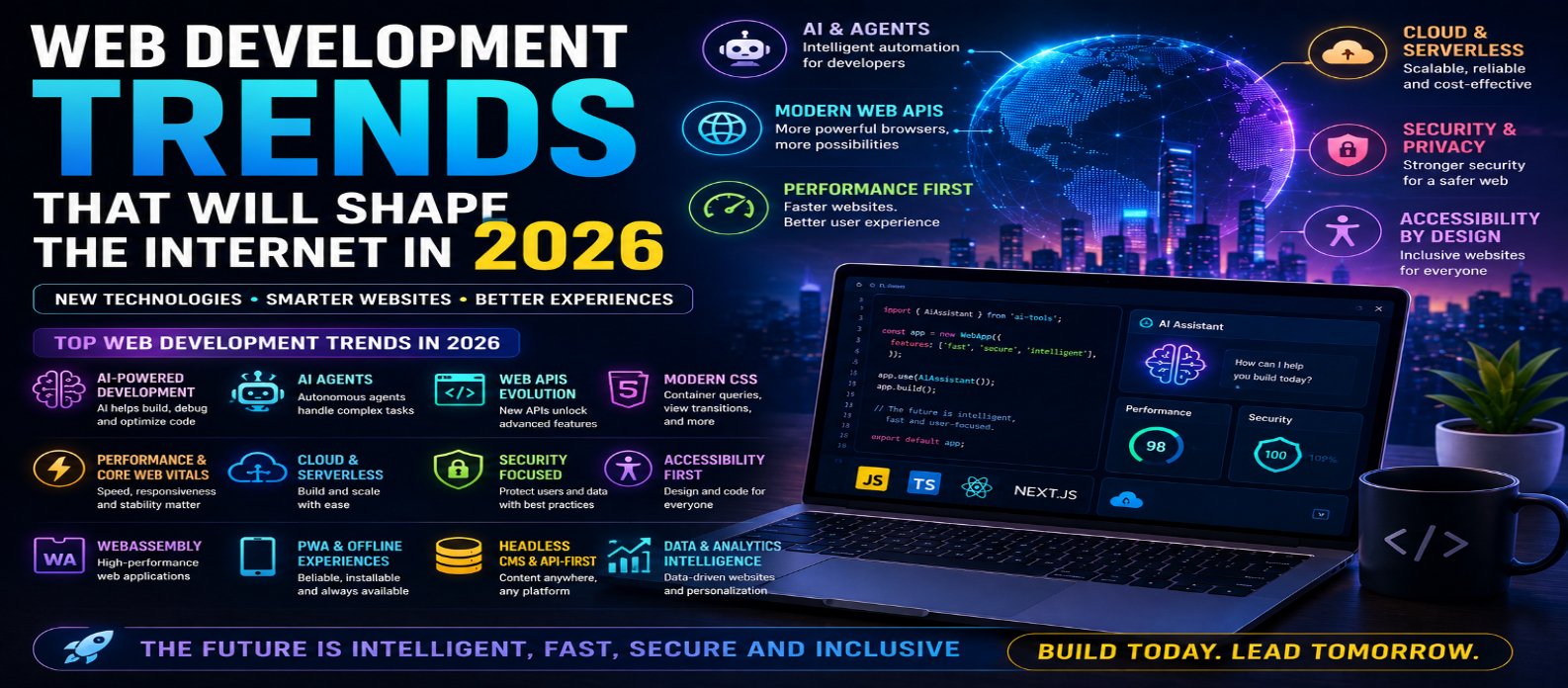
"Discover the top web development trends shaping the internet in 2026, including AI-powered development, AI agents, browser-based AI, modern Web APIs, advanced CSS, WebAssembly, cloud computing, security, accessibility, and performance."
Web Development Trends That Will Shape the Internet in 2026
Web development is evolving rapidly in 2026 as artificial intelligence, modern browser capabilities, performance standards, security requirements, and new ways of interacting with websites reshape the internet.
For developers and website owners, keeping up with these changes is not simply about following trends. It helps businesses build websites that are faster, smarter, more accessible, secure, and prepared for future technologies.
Here are the most important web development trends shaping the internet in 2026.
1. AI-Powered Web Development
Artificial intelligence has become one of the biggest changes in modern development workflows.
Developers increasingly use AI to assist with:
- Code generation
- Debugging
- Documentation
- Testing
- UI development
- Code review
- Research
- Automation
AI doesn't eliminate the need for programming knowledge. Developers still need to verify generated code for correctness, security, performance, and maintainability.
2. AI Agents and Agentic Development
AI development is moving beyond simple coding assistants toward AI agents capable of performing multi-step development tasks.
Agents can potentially analyze projects, modify files, run tools, test changes, and iterate toward a goal.
Google's 2026 developer announcements highlight this transition toward more agentic software-development workflows. (developers.googleblog.com)
Developers will increasingly need skills in directing, reviewing, testing, and securing agent-generated work.
3. Websites Built for AI Agents
Websites have traditionally been designed for humans and search-engine crawlers. A new category of visitor is emerging: AI agents.
Google's proposed WebMCP standard is designed to allow websites to expose structured tools that browser-based AI agents can interact with more reliably. (developers.googleblog.com)
This could eventually change how developers design forms, services, booking systems, shopping experiences, and other interactive workflows.
4. AI Features Inside Websites
AI is not only helping developers build websites—it is increasingly becoming part of the finished product.
Modern web applications can include:
- AI chatbots
- Intelligent search
- Personalized recommendations
- Content summarization
- Natural-language interfaces
- Document analysis
- Image understanding
- AI customer support
Web.dev's AI learning resources now cover both predictive and generative AI use cases for web developers. (web.dev)
5. Browser-Based AI
Some AI workloads are moving directly into web browsers.
Client-side AI can offer advantages such as reduced server dependence, lower latency for certain tasks, and improved privacy when data can remain on the user's device.
Google introduced LiteRT.js in 2026 for running machine-learning models in web applications using technologies such as WebGPU, WebNN, and WebAssembly depending on the environment. (developers.googleblog.com)
6. More Powerful Native Web APIs
Modern browsers continue gaining capabilities that previously required libraries, plugins, or complicated workarounds.
Baseline 2026 tracks numerous newly interoperable features across CSS, JavaScript, HTML, WebAssembly, security, networking, and browser APIs. (web.dev)
Developers should increasingly check whether the web platform already provides a feature before adding another dependency.
7. Modern CSS Becomes More Powerful
CSS continues to evolve into a more capable layout and interface language.
Modern capabilities include areas such as:
- Container queries
- Advanced selectors
- Improved responsive layouts
- Modern color features
- Better animations
- View transitions
Several newer CSS capabilities have entered or progressed through Baseline, making modern CSS increasingly practical across browsers. (web.dev)
8. Performance Remains a Priority
Users expect websites to load quickly and respond immediately.
Developers should continue focusing on:
- Image optimization
- Efficient JavaScript
- Caching
- CDN usage
- Fast servers
- Code splitting
- Resource prioritization
- Core Web Vitals
Google's Core Web Vitals continue to measure important aspects of user experience through LCP, INP, and CLS. (web.dev)
9. Accessibility Becomes a Core Development Requirement
Accessibility is increasingly treated as a fundamental part of professional web development rather than an optional enhancement.
Modern websites should support:
- Keyboard navigation
- Screen readers
- Semantic HTML
- Accessible forms
- Visible focus states
- Appropriate contrast
- Responsive interfaces
Accessibility benefits users with disabilities while often improving usability and structure for everyone.
10. Security Becomes More Important
As websites integrate more APIs, cloud services, third-party systems, and AI capabilities, their potential attack surface can increase.
Developers should understand:
HTTPS → Authentication → Authorization → XSS → CSRF → Content Security Policy → API Security → Secure Data Handling
AI applications introduce additional considerations such as prompt injection, excessive permissions, sensitive-data exposure, and unsafe tool execution.
11. Cloud and Serverless Development
Cloud platforms continue to simplify application deployment and scaling.
Developers can use managed infrastructure for:
- Databases
- Authentication
- File storage
- APIs
- Serverless functions
- Monitoring
- Content delivery
Serverless architectures can reduce infrastructure management for suitable applications, although developers still need to consider costs, performance, security, and platform limitations.
12. Progressive Web Applications Continue to Evolve
Progressive Web Apps combine web technologies with application-like capabilities.
Depending on browser and platform support, PWAs can provide:
- Installable experiences
- Offline functionality
- Push notifications
- Background capabilities
- Responsive interfaces
PWAs remain useful when businesses want broader web reach combined with selected app-like functionality.
13. WebAssembly Expands Web Possibilities
WebAssembly allows high-performance code to run in browsers alongside JavaScript.
It is especially useful for demanding applications such as:
- Games
- Video processing
- Image editing
- Developer tools
- Data visualization
- Scientific applications
WebAssembly continues to be part of the expanding modern web platform tracked through Baseline. (web.dev)
14. Cross-Browser Compatibility Becomes Easier to Track
Developers have traditionally struggled to know when newer web features are safe to use.
The Baseline initiative provides clearer information about browser interoperability. Lighthouse has also gained a Baseline Features audit that can identify the availability status of web-platform features detected on a page. (web.dev)
This can help teams adopt modern features with greater confidence.
15. Developers Become AI-Orchestrated Problem Solvers
Perhaps the biggest trend is the changing role of the developer.
The future developer may spend less time manually producing repetitive code and more time on:
Planning → Architecture → AI Direction → Code Review → Security → Testing → Optimization → User Experience
Strong fundamentals remain essential because developers need enough technical knowledge to recognize when AI-generated solutions are wrong.
What Should Developers Learn in 2026?
A practical learning path is:
HTML → CSS → JavaScript → TypeScript → Git → Frameworks → APIs → Databases → Cloud → Security → Performance → Accessibility → AI → AI Agents → Modern Web APIs
Don't chase every new framework. Focus on technologies that solve real problems and build projects that demonstrate practical skills.
Conclusion
The biggest web development trends of 2026 show that the internet is becoming more intelligent, capable, automated, and performance-focused.
AI-powered development, AI agents, browser-based AI, modern Web APIs, advanced CSS, cloud infrastructure, WebAssembly, security, accessibility, and performance optimization are all influencing how future websites will be built.
But one principle remains unchanged: strong web fundamentals matter.
Developers who combine HTML, CSS, JavaScript, security, accessibility, and performance knowledge with AI and modern browser technologies will be better prepared to build the next generation of the internet.
Get a Free Access To 200+ Free Tools:
|
Home Page |
|
|
Calculator Tools |
|
|
Text & Converter Tools |
|
|
PDF & Image Tools |
|
|
Games & Developer Tools |
|
|
Resume Builder |